
How to File a New York Auto Insurance Claim
A New York auto insurance claim is easier to control when you separate the accident into the right tracks from the beginning. This guide explains how to file a New York auto insurance claim using a New York claim checklist that protects New York claim evidence, keeps the New York insurance claim deadline visible, and separates the injury/No-Fault file from the vehicle-damage and liability file. It also shows how major insurers route estimates and repairs without treating any brand as automatically faster or better.
This quote form does not report an accident, open a claim, submit an NF-2 or MV-104, or preserve a filing deadline. First report the loss to the responsible insurer and complete any required New York filings. Use the form only if you later want to compare renewal or replacement coverage with the same driver, vehicle, limits and deductibles.
QuotesAutoInsurance.org is independently operated and is not a government agency, insurer, claims administrator or law firm. The form may connect users with licensed insurance providers or partners and does not report a claim, preserve a legal deadline, guarantee coverage or determine fault.
New York Auto Insurance Claims Process: Separate the Injury and Damage Tracks
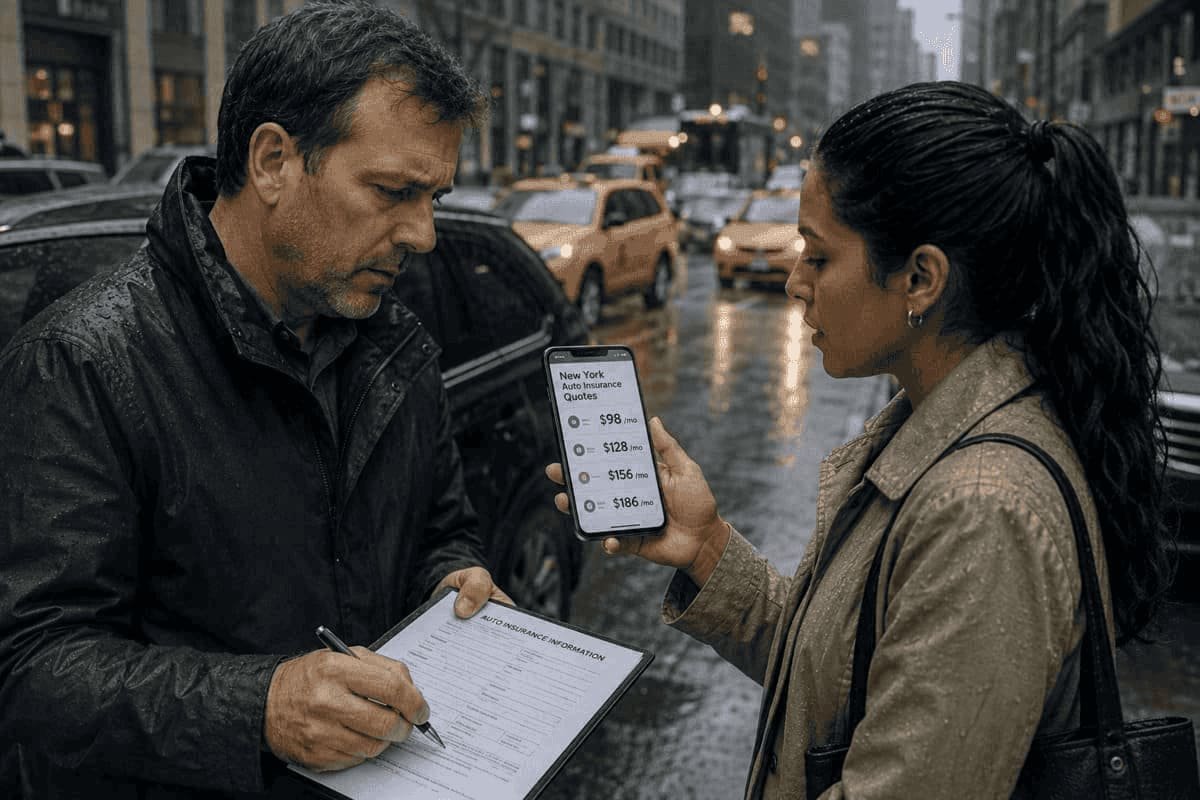
A New York car accident insurance claim starts with the facts, not with fault arguments. Create one incident record containing the date, time, exact location, drivers, passengers, vehicles, plates, insurance information, witnesses, responding agency, report number, photos, videos, medical providers, towing information and every later insurer communication. That record becomes the working file for a New York accident claim and for any auto insurance claim in New York arising from the same crash.
If you are searching how to file car insurance claim in New York, the key is to avoid treating every document as one claim form. A New York insurance claim after accident may produce separate claim numbers for vehicle damage, injuries, another driver's liability carrier, or uninsured-motorist issues. The broader New York DMV insurance requirements guide explains the state coverage framework; this page is about operating the loss file correctly after the incident.
The New York auto claim timeline below uses legal and policy checkpoints rather than a generic “day 1, week 2, week 4” promise. Actual investigation and repair time varies by facts, coverage, documentation, parts, liability disputes and the insurer’s need for verification.
Step 1: Secure the Scene and Build the Evidence File
Safety comes first. If anyone is injured or killed, New York requires immediate police notification. For a property-only crash, exchange driver-license, registration and insurance information. If a parked vehicle or other property is damaged and the owner is not present, locate the owner or contact police. Do not delay emergency care to photograph a vehicle.
New York claim evidence should show the whole scene as well as close damage. Capture vehicle positions, plates, traffic controls, lane markings, debris, weather and lighting, visible injuries, dashcam files and contact details for independent witnesses. Photograph documents rather than relying on memory, but avoid posting the evidence publicly while the claim is open.
Open a written New York claim checklist immediately after the scene. Record the insurer claim number, adjuster or examiner contact, police agency and report number, towing location, storage charges, medical visits, work absences, repair estimates and every deadline. Save emails, texts, portal messages, receipts and uploaded-file confirmations in date order.
A New York insurance claim deadline can arise from statute, regulation, the policy or a requested verification. Reporting the accident promptly to the insurer is therefore separate from completing the DMV and No-Fault tasks described below.
Step 2: File the Correct Police and DMV Reports
The motorist report is New York MV-104, not the police accident-report form. A New York DMV accident report is required for a reportable crash, including when a person is injured or killed or when damage to the property of any one person, including yourself, exceeds $1,000. This is the New York $1,000 accident report threshold.
A New York police accident report documents the responding agency’s crash record. A New York crash report filed by the motorist is a separate DMV obligation. If injury or death occurred, police must be notified immediately; filing an insurer claim does not replace the DMV filing.
For a reportable crash, remember the phrase New York accident report 10 days: DMV states that the motorist crash report must be filed within 10 days. Keep a copy or submission confirmation with the claim file. The DMV also explains that a crash appearing on a driving record does not itself establish fault because DMV does not determine fault in the crash-report process.
| Reporting track | When it matters | Control point |
|---|---|---|
| Police | Immediate police notice is required if a person is injured or killed; other duties can apply by crash circumstances. | Keep agency, precinct and report number. |
| DMV motorist report | Reportable crash, including injury/death or more than $1,000 damage to one person’s property. | File MV-104 within 10 days. |
| Insurer notice | Loss that may trigger policy coverage or defense duties. | Report promptly under policy requirements. |
| No-Fault notice | Eligible injury benefits. | Track the separate 30/45/90 sequence. |
Step 3: Open the New York No-Fault Injury Track
A New York PIP claim is the injury-benefit track. For an accident in New York, an occupant generally files with the insurer of the vehicle occupied; a pedestrian generally files with the insurer of the vehicle that struck them. The New York no-fault insurer can therefore be different from the company handling vehicle damage or a bodily-injury liability dispute.
The New York No-Fault 30 day deadline applies to written notice of claim: DFS says notice should be given as soon as reasonably practicable and no later than 30 days after the accident unless clear and reasonable written justification supports delay. The New York medical bill 45 day deadline concerns submission of health-care bills, and the New York lost wage 90 day deadline concerns loss-of-earnings claims.
After receiving written notice, the insurer generally sends the New York no-fault application for benefits and an explanation of coverage and obligations within five business days. The application is commonly associated with the New York NF-2 form. Complete requested information carefully, preserve proof of submission and keep medical and wage documentation separated by date.
| No-Fault item | General New York control period | What to save |
|---|---|---|
| Written notice | As soon as reasonably practicable; generally no later than 30 days after the accident. | Notice, confirmation and any late-filing justification. |
| Medical bills | Generally within 45 days after services are rendered. | Bills, treatment records, assignments and upload/mail proof. |
| Lost earnings | Generally within 90 days. | Employer/self-employment wage verification and submissions. |
A New York hit and run insurance claim or New York uninsured motorist claim can require a different route. DFS states that when an injured person and resident relative have no applicable auto policy and the injury involves an uninsured vehicle or hit-and-run driver, MVAIC may be the No-Fault path; special reporting requirements can apply, so act quickly.
If benefits are denied, a New York no-fault claim denial should be read against the exact reason and requested proof. DFS identifies a Department complaint, New York no-fault arbitration, and court action as possible dispute routes in appropriate circumstances. Keep the denial, NF forms, medical bills, wage proof, verification requests and delivery records together.
Step 4: Open the Vehicle-Damage and Liability Track
The property track depends on which coverage and whose policy is being used. A New York first party auto insurance claim uses your own applicable coverage; a New York third party auto insurance claim seeks payment under another party’s liability coverage. A New York liability claim is not the same as a New York No-Fault injury-benefit submission.
A New York collision claim usually addresses covered collision damage to your vehicle subject to the policy deductible. A New York comprehensive claim can address covered non-collision losses. Depending on the facts and policy, that broader category can include a New York glass claim, New York theft claim, New York vandalism claim or New York weather damage claim.
A New York property damage claim against another driver can depend on liability investigation. If you instead use your own collision coverage, a New York auto insurance deductible claim means the deductible can initially remain your responsibility even when another person may ultimately be liable.
For first-party collision or comprehensive claims, DFS describes a New York auto damage inspection rule under Regulation 64. When the insurer intends to inspect before repair and the vehicle is available at a reasonably convenient time and place, the New York six business day inspection period generally requires inspection and a good-faith repair offer within six business days after notice of loss.
The resulting New York repair estimate should be detailed and should not be confused with a final repair invoice. If the repair facility later uncovers covered hidden damage, request a New York supplemental repair estimate and let the shop coordinate the supplement with the adjuster before additional disputed work proceeds.
New York repair shop choice remains with the vehicle owner. DFS states that an insurer can identify a conveniently located shop that will repair at its estimated cost and provide an insurer-backed written guarantee, but New York choose your own repair shop remains the consumer’s right. Network programs are optional service paths, not a transfer of that choice.
A New York rental reimbursement claim depends on the applicable policy coverage or liability situation. Do not assume a rental is automatically included merely because the insured vehicle is being repaired.
Step 5: Use the Insurer’s Claim Channel Without Giving Up New York Rights
The brand layer on this page is operational: how to transmit evidence, obtain an estimate, select a shop and track the file. It is not a ranking of claim speed. The exact policy, issuing company, coverage, loss facts and New York rules remain controlling.
A GEICO New York claim or GEICO auto claim can be reported and managed through GEICO’s online or mobile claims tools. GEICO Easy Photo Estimate can be offered for eligible damage and lets the claimant upload guided vehicle photos for an adjuster’s estimate. After the claim is stable, drivers who want fresh pricing can get a GEICO quote using the same coverage baseline.
If a repair shop finds additional damage after a GEICO photo estimate, GEICO instructs the shop to contact the auto adjuster. That makes supplement control part of the evidence file rather than a reason to assume the first photo estimate is the final repair amount.
A State Farm New York claim or State Farm auto claim can be filed or tracked online or in the app, with tools for documents, photos, claim status and repair selection. State Farm Select Service is an optional network route, while State Farm states that the customer can choose another repair shop. After the loss is stable, compare State Farm auto insurance quotes on the same limits and deductibles.
A Progressive New York claim or Progressive auto claim can be reported and managed through Progressive’s claims channels. Progressive Photo Estimate may be available for eligible claims through the mobile workflow; Progressive also states that a claimant can use a repair shop outside its network. When it is time to re-shop, check a progressive quote online separately from the open claim.
An Allstate New York claim or Allstate auto claim can be filed and tracked through Allstate’s account and claim tools, including document/photo handling and repair options. Allstate Good Hands Repair Network is an optional network; Allstate states that the claimant remains free to choose another repair shop. For later re-shopping, compare an allstate quote online separately from the open claim.
Step 6: Resolve Repairs, Total Loss, Deductible Recovery and Disputes
Do not close the file when the first estimate arrives. Match the final repair invoice or settlement to the coverage decision, deductible, supplements and payment. For an agreed physical-damage settlement, DFS states that a New York claim settlement payment generally must be made within five business days after the insurer and insured agree on the settlement. This is the New York five business day settlement payment control point.
For a covered first-party physical-damage loss, a New York total loss claim can be settled using New York actual cash value under the governing standards. DFS describes ACV as retail value plus applicable sales tax, subject to depreciation and applicable deductions; therefore New York total loss sales tax should be checked in the settlement calculation rather than assumed to be outside value.
If the only dispute is the amount of damage, a New York appraisal clause in the policy may provide a structured appraisal process. A New York auto claim dispute can also concern coverage, liability, No-Fault benefits, delays or claim practices, so the correct dispute path depends on what is actually contested.
A New York insurance complaint can be filed with DFS for insurance-related issues. For a denied or overdue No-Fault benefit, arbitration can also be an available path. Keep the claim number, declarations, estimate, supplements, denial or delay letters, proof of submission and a concise chronology before escalating.
If your insurer pays a physical-damage loss subject to a deductible and later recovers from a responsible third party, New York subrogation claim rules can create a pro-rata New York deductible recovery. Regulation 64 contains notice and payment rules for that recovery; do not assume the entire deductible will always be recovered.
After the loss is stable, New York insurance after accident becomes a separate renewal decision. New York auto insurance after a claim should be compared with the same vehicle, drivers, garaging ZIP, limits and deductibles. Use the provider page to compare New York auto insurance companies on that fixed carrier-fit baseline rather than assuming one insurer is universally best.
If you want to compare New York auto insurance after a claim, first preserve uninterrupted required coverage and then review New York insurance renewal after claim pricing on equal terms. The state hub covers New York insurance by ZIP code and the broader New York auto insurance quotes by ZIP workflow.
New York auto insurance quotes after accident should not be compared by changing the deductible to make one premium look lower. For another location-based comparison on one of our related sites, review car insurance by ZIP code while holding coverage and deductibles constant.
Finally, check whether legitimate discounts still apply at renewal rather than assuming the claim automatically removes every credit. The New York auto insurance discounts page separates statutory savings, including qualifying accident-prevention-course credits, from insurer-specific discounts and eligibility rules.
New York Auto Insurance Claim FAQ
These answers summarize the main reporting, No-Fault, repair and post-claim controls. A serious injury, disputed liability, coverage denial, large loss or approaching deadline can justify advice specific to the facts.
Start with safety and evidence, promptly notify the appropriate insurer, and keep the claim number and written communications. If the crash is reportable, separately complete the required DMV crash report. If anyone is injured, also open the applicable No-Fault claim and track its own filing deadlines.
A driver involved in a reportable New York crash must file the motorist crash report with DMV within 10 days. Reportable crashes include those involving injury or death and those where damage to the property of any one person, including yourself, exceeds $1,000.
Written notice of a No-Fault claim generally must reach the applicable No-Fault insurer as soon as reasonably practicable and no later than 30 days after the accident, unless clear and reasonable written justification supports a late filing. Medical bills generally have a 45-day submission deadline and lost-earnings claims a 90-day deadline.
Yes. New York DFS guidance states that you retain the right to choose the repair shop for your damaged vehicle. An insurer may offer a network or identify a shop that will repair at its estimate, but that does not eliminate your repair-shop choice.
For a first-party collision or comprehensive claim, if the insurer intends to inspect before repair and the vehicle is available at a reasonable time and place, New York Regulation 64 generally requires inspection and a good-faith offer within six business days after notice of loss.
Do not treat the first estimate as the final repair scope. Have the shop document newly discovered damage and contact the insurer or adjuster for a supplemental review before additional covered work is performed. Keep the original estimate, supplement, photos and repair authorization together.
For a covered first-party physical-damage claim, New York DFS describes total-loss payment as actual cash value, including retail value plus applicable sales tax and subject to depreciation and applicable deductions, or a substantially similar replacement under the governing standards.
Review the written denial and the reason given. Depending on the issue, DFS identifies options that can include a Department complaint, No-Fault arbitration, or a court action. Preserve the denial, medical submissions, proof of mailing or upload, and any verification requests.
The 2026 reforms changed several motor-vehicle insurance and tort rules, including the serious-injury definition and comparative-negligence framework for covered personal-injury actions. Current DFS No-Fault guidance still states the separate 30-day notice, 45-day medical-bill and 90-day lost-earnings submission timeframes.
Do not let shopping interfere with the open loss. Keep the claim active with the insurer responsible for the loss and preserve required cooperation and documents. If you later compare renewal options, use the same drivers, vehicle, garaging ZIP, limits and deductibles and avoid creating any gap in required New York coverage.
Bottom line: the strongest way to handle a New York auto insurance claim is to build one evidence file and then run the required tracks separately. Report the loss promptly, complete any required MV-104, protect the 30/45/90 No-Fault sequence, document every physical-damage estimate and supplement, use insurer tools without surrendering repair-shop choice, and verify the final settlement before moving on to post-claim shopping.