
Affordable Auto Insurance in California by ZIP
Affordable auto insurance California shoppers can trust is not simply the lowest number on a quote screen. California has its own legal minimums, Proposition 103 rating framework, statutory Good Driver protection and a state-sponsored low-cost option for qualifying drivers. This page uses a California Affordability Ladder + Quote Guardrail System: establish the legal floor, identify the California-specific savings lane, normalize the quote, test one price lever at a time and verify the full policy-term cost before buying.
Use the ZIP where the vehicle is actually garaged. Keep the same drivers, vehicle, liability limits, collision and comprehensive choices, deductibles, optional coverage and effective date in every quote so the price comparison measures the insurer rather than a weaker policy.
QuotesAutoInsurance.org is independently operated and is not the California Department of Insurance or an insurance company. The form may connect users with licensed insurance providers or partners. Availability, eligibility, coverage and price vary by insurer and applicant.
How to Make California Car Insurance Affordable Without Weakening Coverage
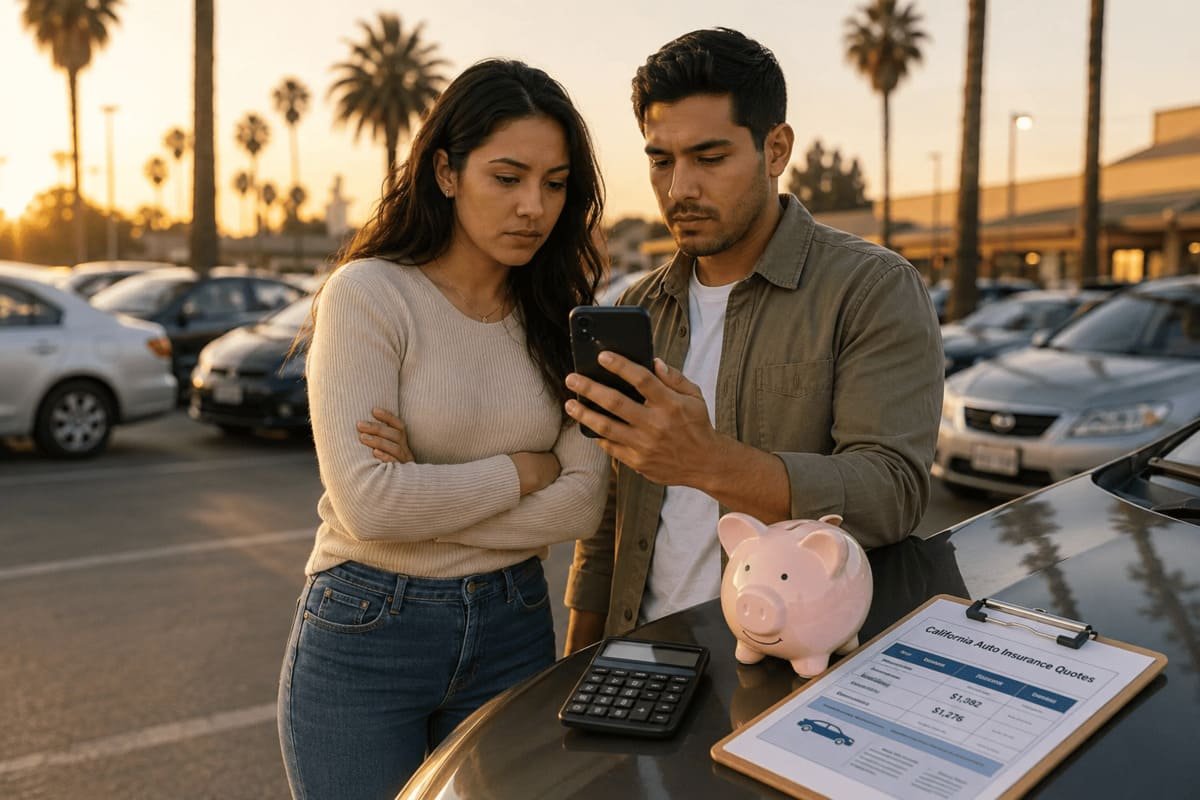
California affordable auto insurance is best treated as a sequence of decisions rather than a hunt for one statewide winner. California cheap car insurance may mean a minimum-liability policy for one driver, while affordable full coverage California may be the relevant target for a financed or higher-value vehicle. The quote has to fit the vehicle, household and loss exposure.
California auto insurance quotes and California car insurance quotes can vary even when the driver appears similar because insurers apply approved rating plans to the facts presented. For California auto insurance by ZIP code, compare California car insurance rates using the real garaging location and consistent quote inputs.
California auto insurance rates and California car insurance rates are also different from a generic national average. The California Auto Premium Survey is useful as a comparison benchmark, but the California Department of Insurance explains that survey premiums are hypothetical profiles rather than personalized quotes. That is why this page does not publish a fake universal "$X per month" promise.
Step 1: Lock the California 30/60/15 Legal Floor
California auto insurance 30/60/15 is the current standard liability floor. California minimum liability insurance requires $30,000 for bodily injury or death to one person, $60,000 for bodily injury or death to more than one person in one accident and $15,000 for property damage. California 30 60 15 insurance became the standard minimum for policies beginning in 2025.
California minimum car insurance should not be confused with the older 15/30/5 limits that appeared on many legacy pages. California liability insurance 30/60/15 is the relevant standard-policy starting point today. California auto insurance laws set the legal framework; the dedicated California minimum liability insurance page keeps those requirements separate from this affordability workflow.
| Coverage decision | Affordability question | Guardrail |
|---|---|---|
| California liability only insurance | Is the vehicle value low enough that self-funding its damage is realistic? | Do not mistake legal compliance for protection of your own vehicle. |
| California full coverage auto insurance | Would collision and comprehensive protect a loss you could not easily absorb? | Compare equivalent collision, comprehensive and deductibles across companies. |
| California collision and comprehensive insurance | What does each deductible change save over the full term? | Keep the claim-time deductible affordable. |
| California uninsured motorist coverage | What UM protection is being offered and at what price? | Do not remove it simply to make one quote look cheaper. |
| California underinsured motorist coverage | Does the selected protection address a driver whose liability limits are insufficient? | Review the written offer and rejection choices. |
California UM UIM insurance is a separate coverage decision from the liability floor. California auto insurance coverage options should be compared before changing limits or removing optional protection; review California collision and comprehensive coverage on the same vehicle and household profile.
Step 2: Use California Rating Factors, Not Out-of-State Myths
California Proposition 103 auto insurance changes the way an affordability analysis should be built. California Insurance Code 1861.02 places the insured's driving safety record first, annual miles second and years of driving experience third, followed by other factors approved by the Insurance Commissioner that have a substantial relationship to risk.
| Search intent | What to make consistent | Why it matters |
|---|---|---|
| California driving safety record insurance | Use accurate convictions, accidents and driver history on every application. | Driving safety record is the first statutory rating factor. |
| California annual mileage insurance rate | Use a realistic annual mileage estimate and the same vehicle use. | Annual mileage is the second statutory rating factor. |
| California years licensed insurance rate | Report driving experience consistently and accurately. | Years of driving experience is the third statutory rating factor. |
Searches for California auto insurance rating factors often lead to generic national lists. A California auto insurance credit score article copied from another state can therefore be misleading. If the question is does California auto insurance use credit scores, the safer California-specific answer is to start with the Prop 103 statutory and commissioner-approved factor framework rather than assume a generic credit-based insurance score is part of the quote.
California auto insurance garaging ZIP still matters because approved rating plans can include location-related factors. Use the actual place where the vehicle is principally garaged. California auto insurance mileage should also reflect actual expected use; California low mileage car insurance savings, where available, should be tested using a truthful mileage estimate rather than an artificially low number.
To compare California auto insurance rates fairly, use the California rate comparison only after the driver, mileage, years licensed, vehicle, garaging location, coverage and deductibles are aligned.
Step 3: Check the 20% California Good Driver Rule and CLCA
The California Good Driver Discount is not just a marketing label. Under California Insurance Code 1861.02, a qualifying California good driver policy must be priced at least 20% below what that insured otherwise would have been charged for the same coverage. The California 20 percent Good Driver Discount is therefore one of the first statutory savings checks in an affordability review.
California Insurance Code 1861.025 defines the eligibility test for California good driver insurance. It includes required licensing history and driving-record conditions, including limits on violation points, principally-at-fault injury accidents and specified serious convictions. California car insurance for good drivers should be quoted using the insurer's current application questions rather than assuming "no ticket recently" automatically satisfies every statutory condition.
The California low cost auto insurance program, also searched as California CLCA insurance or CLCA California auto insurance, is designed for eligible drivers who meet program requirements. Current California low cost insurance eligibility includes income requirements, vehicle-value rules, age and licensing conditions, plus the program's driving-record requirements or new-driver path.
For California low income car insurance, the current program says the applicant generally needs a California license, qualifying household income, a vehicle valued at $25,000 or less and the other program conditions. California income eligible auto insurance thresholds can change, so check the official program at application time. California CLCA vehicle value is currently capped at $25,000.
California CLCA 10/20/3 refers to the program's special basic liability limits: $10,000 bodily injury or death per person, $20,000 per accident and $3,000 property damage. Those are not the standard 30/60/15 limits. California car insurance for low income drivers should therefore be judged on both program eligibility and the protection provided.
Step 4: Compare GEICO, State Farm, Progressive and Allstate on a Fixed Baseline
Once the legal and statutory-savings lanes are set, compare California auto insurance companies without changing the quote setup. A California insurance quote comparison should use the same vehicle, drivers, California auto insurance garaging ZIP, mileage, coverage, deductibles, effective date and payment method. A California insurance rate comparison is useful only when those inputs remain stable.
GEICO California auto insurance can include California-specific Good Driver, Good Student and vehicle-safety discount opportunities for eligible drivers. If GEICO is one candidate, compare GEICO insurance rates with the same limits and deductible as the other quotes rather than importing a national advertised price.
State Farm California auto insurance has a California-specific discount page listing California Good Driver, Good Student, multiple automobiles, multiple line, student-away, mature-driver and vehicle-safety opportunities subject to eligibility. One important California distinction is that State Farm says Drive Safe & Save is not available in CA. When pricing the brand, compare State Farm insurance quotes without assuming that national telematics program is part of the California savings stack.
Progressive California auto insurance publishes the current 30/60/15 state minimums and California-specific discount categories. When Progressive is in the set, compare progressive insurance prices on identical coverage and confirm which discounts are actually included rather than estimating a national average savings amount.
Allstate California auto insurance lists California opportunities such as multiple-policy or bundling, Safe Driver and Good Student discounts. When Allstate is included, review allstate auto insurance pricing after the coverage baseline is locked.
The goal is not to crown one company as best affordable car insurance California for every driver. Searches for best cheap car insurance California should resolve to a driver-specific comparison. Use the provider page to compare California auto insurance companies by fit, while this page remains focused on the affordability ladder.
Step 5: Test Deductibles, Bundles and Discounts One Change at a Time
California auto insurance discounts and California car insurance discounts should be tested after the base quote is saved. Change one variable, record the new full-term premium and then restore the baseline before testing another variable. That prevents a bundle, deductible and coverage change from being misread as one giant "discount."
| Lever | What to compare | Do not confuse it with |
|---|---|---|
| California multi policy discount | Auto-only total, home-only total and combined arrangement with equivalent protection. | A guaranteed lowest combined price. |
| California home and auto bundle | Discounted bundle total against the best equivalent separate-policy total. | Dropping home or auto coverage to make the bundle look cheaper. |
| California Good Student Discount | Eligibility, proof requirements and the written premium after the discount. | A universal student discount at every company. |
| California vehicle safety discount | Vehicle eligibility and the coverage component affected. | An assumed discount for every safety feature. |
| California auto insurance deductible | Premium difference between realistic deductible choices. | An insurer discount; you are accepting more claim-time cost. |
A California car insurance deductible should be selected from the amount the household could actually pay after a covered collision or comprehensive loss. Raising it can lower a California auto insurance premium or California car insurance premium, but the savings should be compared with the additional out-of-pocket exposure.
For households that also insure a home, use the same worksheet for a home and auto rate comparison. Match protection first, then compare bundle and separate-policy totals. This keeps the California home and auto bundle decision grounded in combined annual cost rather than an advertised percentage.
California car insurance for students can involve Good Student or student-away opportunities depending on the insurer. California car insurance for new drivers is usually more sensitive to driving experience and household setup, so a new driver should not assume a student discount alone will make the policy inexpensive.
Step 6: Verify the Affordable Quote Before You Buy
An affordable quote is not final until the written offer is checked. California auto insurance full term cost should include the total premium for the policy term, installment or payment charges that apply, confirmed discounts and the cost effect of the selected deductibles. California auto insurance down payment should never be used as a substitute for comparing the total term price.
| Check | What to confirm | Why |
|---|---|---|
| California policy effective date | Date and time the new policy actually begins. | A low quote is useless if it creates a coverage gap. |
| California insurance declarations page | Drivers, vehicles, limits, deductibles, endorsements and discounts. | The issued policy should match the comparison you intended to buy. |
| California auto insurance renewal | Re-shop when household, mileage, vehicle, coverage or discount eligibility changes. | Affordable today does not guarantee best value next term. |
| California car insurance renewal | Compare the new term on the same coverage baseline. | Separates actual rate movement from coverage changes. |
Affordable California auto insurance quotes should therefore be ranked by matched protection and full-term cost. Cheap California car insurance quotes that omit selected coverage, use a different deductible or rely on an inaccurate ZIP are not valid comparisons. To compare California car insurance quotes, save the baseline and change only the carrier first.
Affordable car insurance by ZIP California searches and cheap car insurance by ZIP code California searches are useful entry points, but the ZIP is only one part of the application. The best result comes from accurate California auto insurance mileage, driver history, experience, vehicle information and coverage choices.
Finally, use the California Auto Premium Survey as a market-comparison reference, not as a promise of your personal rate. California Department of Insurance auto insurance survey materials explicitly distinguish sample survey premiums from actual individualized quotes. That makes the official survey a useful reasonableness check while the insurer's written quote remains the actionable price.
Affordable California Auto Insurance FAQ
These answers cover the current legal floor, California rating rules, Good Driver savings, CLCA, deductibles, bundles and quote verification.
For a standard California auto policy, the minimum liability limits are 30/60/15: $30,000 for bodily injury or death to one person, $60,000 for bodily injury or death to more than one person in one accident, and $15,000 for property damage. These standard limits took effect January 1, 2025.
Use the real garaging ZIP and hold the same drivers, vehicle, liability limits, optional coverages, deductibles, effective date and payment assumptions across quotes. Then compare the full policy-term premium and confirmed discounts rather than only the first payment or an advertised starting price.
California automobile rating follows Proposition 103 and approved rating rules. Insurance Code section 1861.02 places driving safety record, annual mileage and years of driving experience first, in that order, followed by other commissioner-approved factors. Do not import generic credit-score shopping advice from another state into a California comparison.
California Insurance Code section 1861.025 sets the eligibility rules. In general, the driver must satisfy the required licensing history and driving-record standards, including the statutory limits on violation points, principally-at-fault injury accidents and specified serious convictions. Check the current statute and insurer application for the complete test.
Insurance Code section 1861.02 requires a qualifying Good Driver Discount policy rate to be at least 20% below what the insured otherwise would have been charged for the same coverage. Compare the final premium because other rating inputs and coverage selections still affect the dollar amount.
CLCA is a state-sponsored program for eligible California drivers who meet program requirements. Current qualifications include income eligibility, vehicle-value limits and licensing or driving requirements. Its special liability limits differ from the standard 30/60/15 policy minimums, so compare the protection as well as the price.
California's Low Cost Auto program uses 10/20/3 basic liability limits: up to $10,000 bodily injury or death per person, $20,000 per accident and $3,000 property damage. California DOI states that these special program limits remained unchanged when standard policy minimums rose in 2025.
No. State Farm's current Drive Safe & Save disclosure says the program is not available in California, Massachusetts or Rhode Island. California shoppers should evaluate State Farm's California-specific discounts rather than assuming a national telematics offer applies.
A higher collision or comprehensive deductible can lower premium, but that is a transfer of claim-time cost to you, not a discount. Test one deductible change at a time and keep enough cash available to pay the selected deductible after a covered loss.
No. A multi-policy discount can reduce one or both premiums, but the best combined result may still come from separate insurers. Compare the equivalent auto quote, equivalent home quote and bundle total with matching coverage, deductibles and fees before choosing.
Bottom line: cheap car insurance California shoppers can actually use comes from the California Affordability Ladder, not a teaser price. Lock the legal floor, apply Prop 103 correctly, test Good Driver or CLCA eligibility, compare carriers on one baseline, isolate each discount or deductible change, and verify the written policy before switching. That process is more reliable than chasing a statewide average and is designed to find California affordable auto insurance without quietly weakening the protection.