
California Auto Insurance Claims Process: File, Document & Settle
California auto insurance claims are easier to control when the driver treats the loss as a documented process instead of a series of disconnected phone calls. This page uses the California Claim Control + Evidence-to-Settlement System: secure the scene, preserve evidence, open the correct claim, track the insurer's response clock, verify repair or total-loss valuation, and escalate a denial or underpayment with a complete written record.
If you shop after a claim, keep the same drivers, vehicle, garaging ZIP, limits and deductibles across quotes. A post-claim price comparison is useful only when the protection being compared stays the same.
QuotesAutoInsurance.org is independently operated and is not the California Department of Insurance, California DMV or an insurance company. This page provides general educational information, not legal advice. Claim rights, coverage and outcomes depend on the facts, policy and applicable law.
Capture vehicles, damage, location and witnesses.
Keep the original photos and documents.
Record the claim number and every request.
Track California response checkpoints.
Review the estimate and repair choice.
Challenge missing damage with evidence.
Keep written explanations.
Escalate a dispute with a complete file.
California Auto Insurance Claims Process: Evidence, Deadlines and Settlement
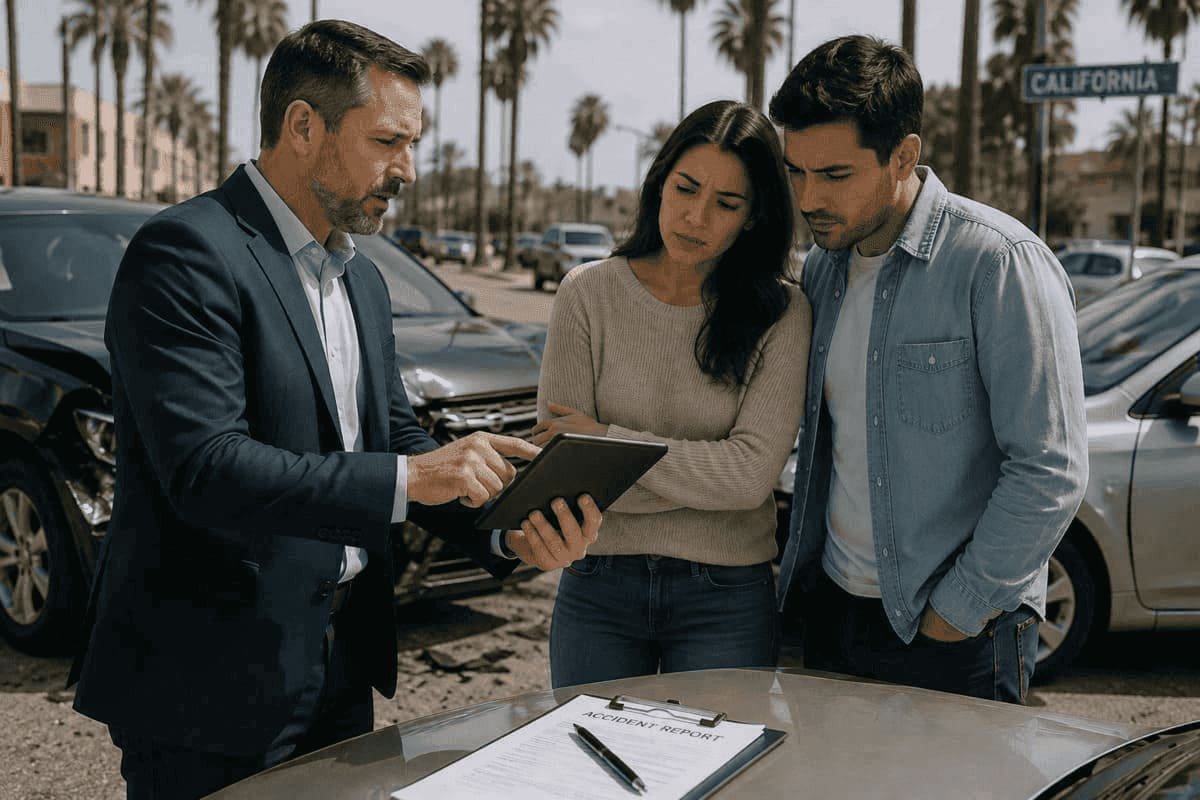
The California car insurance claims process should answer a different question from a coverage or rate page. This page owns the loss-after-it-happens workflow: how to file, what documents matter, how long key insurer responses can take, how estimates and total-loss values are reviewed, and what to do when the claim stalls or the settlement is disputed.
Before an accident, California auto insurance coverage options determine which losses the policy may respond to. After the loss, this page focuses on proving facts, applying those coverages and documenting each claims decision rather than redesigning the policy.
Do not confuse the insurance claim with the DMV reporting obligation. A reportable California collision can require a separate SR-1 within 10 days when anyone is injured or killed or property damage exceeds $1,000. The separate California SR-1 accident report workflow covers that compliance lane; filing an insurer claim does not replace the DMV report.
Step 1: Build the Claim File Before Details Disappear
The best time to create California claims evidence is at the scene, after immediate safety needs are handled. Photograph vehicle positions when safe, damage from several angles, license plates, traffic controls, road conditions and relevant debris or skid marks. Exchange driver, vehicle and insurance information and collect witness contact details when available.
For a California accident insurance claim, write a short factual timeline while details are fresh: date, approximate time, location, direction of travel, weather, traffic conditions, what you observed and what happened next. Avoid guessing about speed, injuries or fault. Preserve original photo files and do not edit away timestamps or metadata before saving a copy.
| Evidence | What to save | Why it matters |
|---|---|---|
| Scene record | Photos, video, location, road and traffic conditions | Preserves facts that may change after vehicles move. |
| People and vehicles | Names, contact details, licenses, plates, VIN and insurance information | Helps identify the parties and available insurance. |
| Independent support | Witness contacts, police or incident information when available | Can support disputed facts or chronology. |
| Loss documents | Towing, storage, repair, rental and medical records when relevant | Supports the amount and category of claimed loss. |
California insurance claim documents are not limited to a police report. The useful file can include the declarations page, policy number, claim number, photos, estimates, invoices, rental receipts, medical documentation, wage information for applicable injury claims, and copies of every material email or letter exchanged with the insurer.
Step 2: Open the Correct Claim and Confirm Which Coverage Is Responding
How to file an auto insurance claim in California depends partly on whose policy is being asked to pay. A California first party auto insurance claim is made under your own policy and can involve collision, comprehensive, Medical Payments, uninsured or underinsured motorist coverage, rental reimbursement or another purchased coverage. A California third party auto insurance claim seeks payment from another driver's liability insurer.
When you file an auto insurance claim in California, provide the basic facts without filling gaps with assumptions. Ask for the claim number, assigned adjuster or team, preferred method for sending documents, the coverage being investigated, any deductible that may apply, and the next expected action. If the insurer asks for a recorded statement or examination under oath, understand what the policy requires before proceeding.
A California auto insurance claim should remain tied to the written policy. The declarations page can show limits and deductibles, but endorsements and exclusions may control a specific loss. If the insurer says a coverage does not apply, ask for the decision and the policy basis in writing instead of relying on a short phone summary.
California uninsured motorist claims and collision claims can follow different coverage rules even when they arise from the same crash. The same is true for rental reimbursement, Medical Payments and physical damage. Treat each claimed benefit as a separate coverage question inside one master claim file.
Step 3: Track the California 15 / 40 / 30 Claims Clock
How long does a car insurance claim take in California? There is no universal fixed completion period. Complexity, missing information, injuries, liability disputes, coverage questions and repair issues can extend a claim. California nevertheless has important claim-handling checkpoints for acknowledgement, communications, acceptance or denial after proof of claim, and payment after settlement.
The California Department of Insurance's consumer summary of Fair Claims Settlement Practices says an insurer should acknowledge the claim, begin the investigation, provide necessary forms and instructions, and provide reasonable assistance immediately but no later than 15 days after notice of claim. Communications that reasonably require a response are also subject to a 15-day response checkpoint.
| Checkpoint | General CDI summary | What the claimant should record |
|---|---|---|
| Notice / acknowledgement | Immediately, but no later than 15 days | Date claim was reported, claim number, forms and instructions received. |
| Claim communications | Response immediately, but no later than 15 days | Date a material question or requested document was sent. |
| Accept or deny after proof of claim | Immediately, but no later than 40 days | Date supporting proof was supplied and any written extension or explanation. |
| Payment after settlement | Immediately, but no later than 30 days after settlement is reached | Settlement date, payees, payment method and amount. |
The official California auto insurance claim rights guide is the single outside reference linked from this article. The detailed Fair Claims Settlement Practices Regulations and Insurance Code remain the controlling sources when a specific timing or claims-handling issue matters.
For California insurance claim deadlines, the California proof of claim date is not simply the day of the crash. “Proof of claim” means evidence in the claimant's possession that supports the claim and the magnitude or amount of loss. Record when requested photos, estimates, reports or other supporting documents were actually delivered.
If a California auto insurance claim timeline stretches beyond the expected checkpoint, ask a precise written question: what information is still needed, what issue remains under investigation, who is responsible for the next action, and when the next written status update should arrive. That is more useful than repeatedly asking whether the claim is “done.”
Step 4: Control the Adjuster, Estimate and Repair Decision with Documents
A California auto insurance adjuster may inspect the vehicle in person, use photos or video, review a body-shop estimate, or request additional information. The initial estimate is not always the final repair cost. Hidden damage discovered during disassembly can lead to a supplement that the repair facility submits for additional review.
For a California car repair insurance claim, compare the estimate line by line with visible and later-discovered damage. Verify labor operations, parts, paint and materials, scans or calibrations where applicable, and whether the estimate identifies prior damage that the insurer is not accepting as part of the loss. Keep the original estimate and every supplement so the settlement history remains auditable.
California rules do not allow an insurer to require a specific repair shop. The insurer may recommend a facility under statutory conditions, but the consumer retains repair-shop choice. A California choose repair shop insurance decision should therefore be based on repair quality, documentation, warranty, parts availability and the shop's ability to communicate supplements—not simply on who appears first in an insurer network.
Claims service is one factor to examine before the next policy term. If Progressive is one carrier you want to price after the loss is closed, request a Progressive quote with the same drivers, vehicle, limits and deductibles used for every other carrier. Treat the quote as a new-policy shopping decision, not as a shortcut for resolving the old claim.
Step 5: Audit Total Loss, ACV, Deductible, Rental and Subrogation Separately
A California total loss insurance claim is a valuation problem as well as a coverage problem. CDI explains that under a standard physical-damage claim the insurer generally pays the lesser of the amount needed to repair the vehicle or its actual cash value. In California, actual cash value is generally fair market value unless the policy defines it differently.
For a California total loss settlement, ask for the valuation report and review the vehicle description before debating the final number. Confirm year, make, model, trim, mileage, options, condition adjustments and the comparable vehicles used. California's consumer guidance also says a total-loss settlement should include applicable taxes, license and transfer fees.
| Issue | Verify | Common source of disagreement |
|---|---|---|
| Vehicle identity | Trim, equipment, mileage and pre-loss condition | Wrong configuration or missing options. |
| Comparable vehicles | Location, model, equipment and reasonable comparability | Poor comparables or unexplained adjustments. |
| Fees and taxes | Items applicable to the total-loss settlement | Missing components in the settlement breakdown. |
| Loan or lease | Lienholder payoff and any GAP protection | Settlement is less than the remaining balance. |
A California car insurance deductible claim should be tracked separately from vehicle valuation. If your own collision coverage pays first, the deductible can initially reduce the payment even when another driver may ultimately be responsible. If your insurer pursues subrogation, California guidance says it must advise you whether it intends to pursue recovery and, if it does, include your deductible unless you have already recovered it.
California deductible recovery can therefore happen later than the main repair payment. Do not sign a release or accept payment from another party for the deductible without understanding whether doing so could interfere with your insurer's subrogation rights.
A California rental reimbursement claim is another separate layer. Under your own policy, rental coverage depends on whether that optional protection was purchased and on its daily and maximum limits. Keep rental dates and receipts aligned with the repair or total-loss timeline and ask when the insurer considers the rental benefit to end.
Step 6: Turn a Denial, Underpayment or Delay into a Written Dispute File
A California auto insurance claim denied in whole or in part should not end with a vague statement such as “not covered.” Ask for the denial or limitation in writing, including the factual basis and the policy provisions relied upon. Then compare those reasons with your declarations, endorsements, exclusions and the evidence in the claim file.
For a California insurance claim dispute over repair cost, identify the exact missing operation, labor issue, part or supplement. For a valuation dispute, identify the wrong vehicle detail, weak comparable or adjustment. For a coverage dispute, identify the policy language and factual assumption that you believe is being applied incorrectly. Specific disputes are easier to review than a general complaint that the offer is “too low.”
California Insurance Code section 790.03 identifies unfair claims settlement practices such as failing to acknowledge claim communications reasonably promptly, failing to adopt standards for prompt investigation, failing to attempt prompt and fair settlement when liability is reasonably clear, and failing to provide a reasonable explanation for a denial or compromise offer. The Fair Claims Settlement Practices Regulations add more detailed operational standards.
If internal escalation does not resolve the problem, the California Department of Insurance accepts requests for assistance and complaints involving insurers, agents and brokers. CDI also operates a California auto insurance mediation program for qualifying physical-damage disputes with a policyholder's own insurer. The current program is limited: it applies to eligible personal-auto collision or comprehensive disputes, not third-party liability claims or pure coverage disputes, and CDI lists minimum claim and disputed-amount thresholds. Verify current eligibility before relying on mediation, and treat a policy appraisal provision as a separate dispute tool.
Claims experience also matters outside auto insurance. Households comparing service after a property loss can review home insurance company ratings on our related project, where claims experience, complaints, financial strength and policy fit are considered separately from price.
Step 7: Close the Claim, Then Separate Claims History from the Next Shopping Decision
A California auto claim settlement is not complete merely because a payment appears. Save the settlement letter or explanation, final repair invoice or total-loss valuation, payment record, deductible status, rental conclusion and any subrogation correspondence. If a lienholder or repair facility is named on the check, confirm that the payment path is complete before treating the claim as closed.
After a claim, avoid changing insurers in the middle of unresolved coverage, payment or subrogation questions unless you understand how the switch affects communication and any open obligations. A new policy does not take over an old claim; the insurer that covered the loss generally continues handling the claim under the policy that was in force on the date of loss.
Once the claim is stable, compare California auto insurance rates by ZIP only with matched limits and deductibles. A different premium can reflect a different policy design, so do not let post-claim shopping accidentally reduce protection you still want.
For the broader state shopping path, use car insurance in California to reconnect claims experience with coverage, provider and ZIP-based quote decisions without turning this claims page into a general rate hub.
California Auto Insurance Claims FAQ
These questions cover the most important California claim steps, insurer timing checkpoints, repair rights, total loss, deductibles and disputes.
Protect people first, call emergency services when needed, move only when safe, exchange driver and insurance information, document vehicles and the scene, collect witness contacts, and notify your insurer promptly. A reportable collision can also require a separate DMV SR-1 within 10 days.
Report the loss to the appropriate insurer by its accepted phone, online, app or agent channel. Provide the basic facts, obtain a claim number, ask which coverage is being investigated, confirm any deductible, and save every request and document in one chronological claim file.
California's CDI consumer summary says the insurer should acknowledge the claim, begin the investigation, provide necessary forms and instructions, and provide reasonable assistance immediately but no later than 15 days after notice of claim. Material claim communications also have a 15-day response checkpoint.
CDI's Fair Claims summary says the insurer should accept or deny the claim immediately but no later than 40 days after receiving proof of claim. Complex or incomplete matters can require additional investigation, so track any written explanation or request for more information.
Once a claim has been accepted and settlement is reached, CDI's consumer summary says payment should be made immediately but no later than 30 days from the settlement date. Keep the settlement date and payment record in the claim file.
Yes. California law does not allow an insurer to require that your automobile be repaired at a specific shop. An insurer can recommend a repair facility under statutory conditions, but the consumer retains the right to choose a repair shop.
The insurer generally compares repair cost with the vehicle's actual cash value. For a total loss, review the valuation report, vehicle configuration, mileage, condition adjustments, comparable vehicles and applicable taxes, license and transfer fees before accepting the settlement.
Not automatically at the time your own collision claim is paid. If your insurer pursues subrogation against the responsible party, California guidance says it must tell you whether it intends to pursue recovery and include your deductible in that effort unless you already recovered it.
Request the decision and policy basis in writing, identify the exact factual, coverage, repair or valuation point you dispute, submit supporting evidence, and escalate through the insurer. If the issue remains unresolved, California Department of Insurance complaint or qualifying automobile claims mediation options may be available.
No. An SR-1 is a DMV accident report required for qualifying California collisions; an insurance claim is a request for benefits or liability payment under an insurance policy. A police or insurer report does not replace a required SR-1 filing.
Bottom line: the strongest California car insurance claim is not the one with the most phone calls; it is the one with the clearest evidence, chronology and decision record. Use the California Claim Control + Evidence-to-Settlement System to preserve facts, open the correct coverage lane, track the claim clock, audit the estimate or total-loss value, and convert any denial or underpayment into a specific written dispute.