
Compare California Auto Insurance Rates by ZIP
California auto insurance rates become useful only when every quote is answering the same question. A lower number can come from a different liability limit, deductible, mileage assumption, garaging location, discount or payment setup rather than a genuinely cheaper insurer. This page uses a California Rate Baseline + Variance Diagnostic System: lock the policy baseline, apply California's rating framework, isolate ZIP and driver-profile variables, benchmark with the state's premium survey, test one savings lever at a time, and compare the full term again at renewal. To see the method on one carrier, read how Progressive prices California policies.
Use the ZIP where the vehicle is actually garaged. Keep the same drivers, vehicle, annual mileage, liability limits, optional coverages, collision and comprehensive deductibles, effective date and payment assumptions across every carrier.
QuotesAutoInsurance.org is independently operated and is not the California Department of Insurance or an insurance company. The form may connect users with licensed insurance providers or partners. Availability, eligibility, coverage and price vary by insurer and applicant.
Keep drivers, vehicle, garaging ZIP and mileage identical.
Use the same effective date, term and payment assumptions.
Keep annual mileage and driving experience consistent.
Do not import a generic national credit-factor model.
Test ZIP, carrier, deductible, discount or bundle separately.
Record what changed before comparing the new premium.
Confirm discounts, fees, limits and effective date in writing.
Repeat the same baseline test again at renewal.
How to Compare California Auto Insurance Rates Without Comparing Different Policies
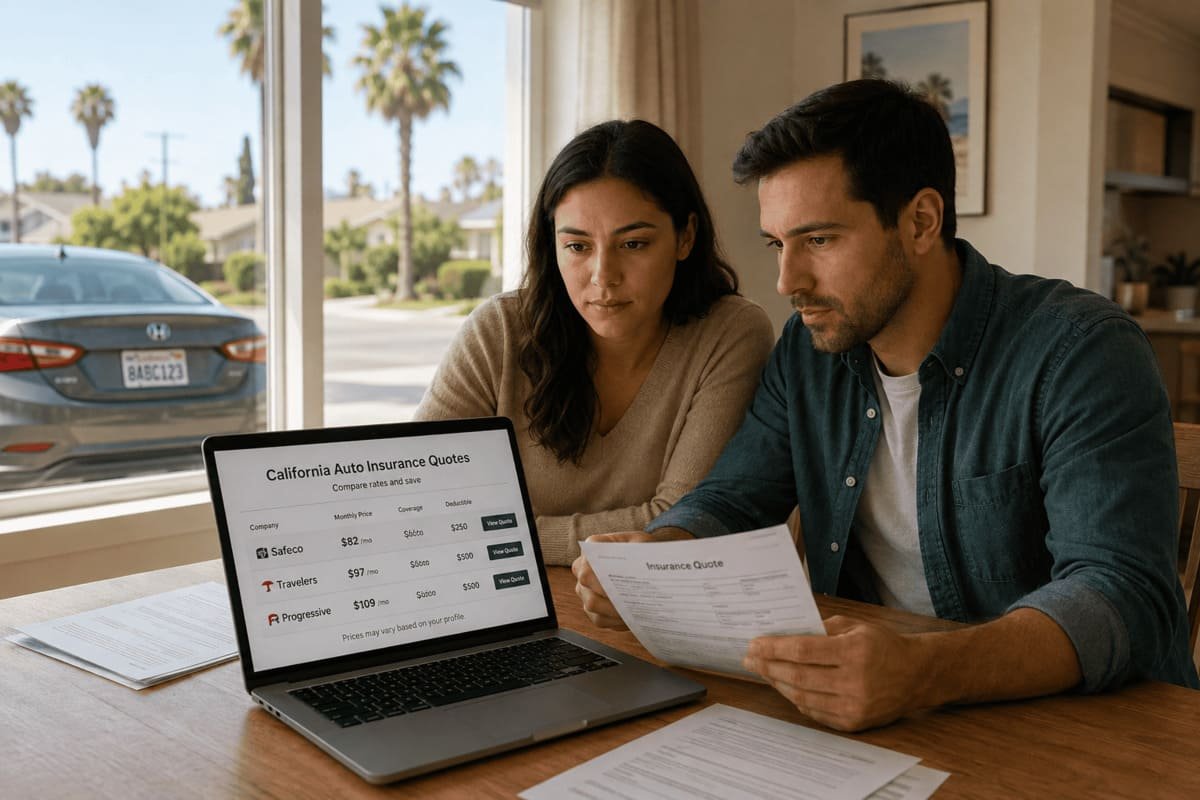
To compare California car insurance rates, begin with California auto insurance quotes and California car insurance quotes built from the same facts. The old useful link to compare rates side by side still fits this workflow because the comparison begins only after the baseline is defined.
Compare California auto insurance quotes and compare California car insurance quotes by recording more than the headline number. A California auto insurance quote comparison and California car insurance quote comparison should include the full term, coverage, deductibles, applied discounts, payment schedule and issuing company.
California auto insurance pricing and California car insurance pricing are not interchangeable with a sample statewide average. A California auto insurance premium and California car insurance premium are individualized outputs produced after an insurer applies its approved rates, discounts and charges to the risk presented.
Step 1: Freeze One Coverage and Deductible Baseline
California quote normalization means every carrier gets the same applicant and policy design. Build a California insurance quote baseline and California auto insurance quote baseline before ranking price. That produces a California matched quote comparison instead of a list of unrelated offers.
| Baseline field | Keep identical | Why |
|---|---|---|
| California auto insurance same coverage comparison | Liability limits, UM/UIM and optional physical-damage coverage | Prevents a weaker policy from appearing cheaper. |
| California auto insurance same deductible comparison | Collision and comprehensive deductibles | Separates carrier price from self-insured claim cost. |
| California coverage limits rate comparison | Exact liability and optional coverage limits | Makes the price difference attributable to the insurer rather than protection. |
| California apples to apples insurance comparison | Drivers, vehicle, mileage, ZIP, term and payment assumptions | Creates a repeatable baseline for renewal. |
For standard policies, a California 30/60/15 rate comparison starts with the current minimum liability floor of $30,000 bodily injury per person, $60,000 per accident and $15,000 property damage. A California minimum liability rate comparison must not use the old 15/30/5 standard. Review California minimum liability insurance before changing the legal floor to chase a smaller price.
A California full coverage rate comparison should keep collision and comprehensive choices fixed. The same rule applies to a California collision comprehensive rate comparison and California UM UIM rate comparison. If those protection decisions are still open, review California collision and comprehensive coverage before judging the carrier price.
Step 2: Read California Rating Factors Before Explaining a Price Difference
California Proposition 103 auto insurance is the starting point for California auto insurance rating factors. Insurance Code section 1861.02 places the insured's driving safety record first, annual mileage second and years of driving experience third, followed by other commissioner-approved factors that have a substantial relationship to risk.
| Rate factor | Exact comparison question | Baseline action |
|---|---|---|
| California driving safety record insurance | Did one quote use different accident or conviction information? | Correct the record before comparing carriers. |
| California annual mileage insurance rate | Did annual miles change between applications? | Use the same realistic mileage estimate. |
| California years licensed insurance rate | Was driving experience entered consistently? | Use the same licensing history. |
California years driving experience insurance and California auto insurance mileage are therefore core rate-comparison inputs. California low mileage auto insurance can produce a different result when an approved plan recognizes lower mileage, but the shopper should not understate expected use simply to obtain a lower estimate.
A search for California auto insurance credit score or does California auto insurance use credit scores should not be answered by copying a generic national factor list. California's statutory framework begins with driving safety record, annual mileage and driving experience; any other factor used for rating must fit California's approved framework. That is why the old page's generic “credit score” bullet has been removed.
Step 3: Isolate ZIP, Garaging and Driver-Profile Variance
California auto insurance rates by ZIP code and California car insurance rates by ZIP code should use the actual location where the vehicle is garaged. Auto insurance rates California ZIP code and car insurance rates California ZIP code searches are useful only when the address is accurate and all other quote inputs remain stable.
California auto insurance garaging ZIP is one part of the individualized quote. The California Department of Insurance's premium-survey notes explain that where a person lives and where a car is garaged can affect the personalized price. A California ZIP code insurance rate can therefore differ by location even when the vehicle and driver appear otherwise similar.
Local California auto insurance rates and California insurance rates by area should not be interpreted as a promise that every nearby driver receives the same price. California location based auto insurance rates can reflect an insurer's approved class plan, and a California auto insurance territory factor should be evaluated only within that approved rating structure.
California auto insurance quotes by ZIP and California car insurance quotes by ZIP are most useful when the shopper records the result for each carrier with the same timestamp, effective date and policy design. That turns ZIP shopping into a controlled rate test rather than a collection of unrelated screenshots.
Step 4: Use the 2026 California Premium Survey as a Benchmark, Not a Quote
The California Auto Premium Survey is one of the strongest public benchmarking tools for this intent. The California 2026 Auto Premium Survey compares sample premiums from insurers using defined profiles, while the California Department of Insurance premium survey explains that survey results are indicators of company differences rather than personalized premium quotes.
California sample auto insurance premiums and California auto insurance survey rates can therefore answer “is this carrier generally higher or lower for this sample profile?” They cannot answer “what will this exact household pay?” A California insurer premium comparison should move from the public benchmark to individualized carrier estimates.
| Tool | Best use | Do not treat it as |
|---|---|---|
| California Auto Premium Survey | Benchmark sample company differences under defined profiles | Your personal premium quote |
| California insurer cost estimate | Obtain an insurer-specific estimate at requested limits when eligible | A substitute for checking the issued policy |
| California AB 2677 auto insurance quote | Use insurer phone/web estimate channels identified through CDI | A guarantee that every applicant receives the same price |
California AB 2677 requires admitted private-passenger auto insurers to provide consumers a way to obtain a cost estimate for the lowest-priced policy at requested limits for which the consumer is eligible, through the permitted phone, website or agent/broker route. That makes the official insurer-contact list useful after the survey narrows the field.
For the next layer, a California auto insurance companies rate comparison and California provider price comparison should use the same quote baseline. If service channel, issuing company and carrier fit also matter, compare California auto insurance companies separately from this pure rate diagnostic.
If GEICO is one of the finalists, run a geico quote with the same drivers, vehicle, garaging ZIP, mileage, liability limits, optional coverages and deductibles used for every other carrier. That keeps the brand check inside the same California rate baseline instead of turning it into a different policy comparison.
Step 5: Test Discounts, Deductibles and Bundles One Variable at a Time
California auto insurance discounts and California car insurance discounts should be measured against the saved baseline rather than added together from advertising. The California Good Driver Discount is especially important because qualifying drivers are entitled to a statutory Good Driver policy, and the California 20 percent Good Driver Discount requires the qualifying rate to be at least 20% below what the driver otherwise would have been charged for the same coverage.
A California good driver insurance rate still depends on the rest of the approved rating plan and policy design. For eligibility and affordability strategy, use the California Good Driver Discount workflow instead of assuming the same dollar savings for every driver.
| Rate lever | Test | Do not confuse with |
|---|---|---|
| California multi car discount | Add the same eligible household vehicles | A guaranteed cheapest carrier. |
| California multi policy discount | Compare separate and combined household totals | The advertised discount percentage alone. |
| California good student discount | Confirm eligibility and proof | A universal student price. |
| California vehicle safety discount | Confirm VIN/equipment eligibility | An assumed savings for every safety feature. |
| California auto insurance deductible | Change one collision/comprehensive deductible at a time | An insurer discount; it shifts claim-time cost to you. |
A California car insurance deductible should be evaluated with a California deductible rate comparison: record the premium at each realistic deductible, then decide whether the term savings justify the additional claim-time exposure. Never compare one carrier at $500 and another at $1,500 and call the lower quote a carrier win.
A California home and auto bundle is another one-variable test. For households that also insure property, compare home and auto bundle deals by ZIP code using equivalent auto-only, home-only and combined protection. Judge the household total, not just the advertised bundle percentage.
Step 6: Compare Full-Term Cost and Renewal Variance Before Switching
California full term auto insurance cost is the number that should rank the finalists. A California six month auto insurance premium and California annual auto insurance premium can use different term structures, so convert the comparison to the actual policy term rather than assuming every carrier quotes the same period.
California auto insurance down payment vs total cost is another common source of false savings. A smaller first payment can coexist with a higher total premium. California auto insurance installment fees should be included when they apply, along with the number and timing of remaining payments.
| Renewal query | What to compare | Diagnostic |
|---|---|---|
| California auto insurance renewal rate | Old and new term using matched protection | Separates rate movement from coverage changes. |
| California car insurance renewal rate | Premium, discounts, mileage and driver changes | Shows which inputs changed before re-shopping. |
| California auto insurance renewal comparison | Current carrier versus matched competitors | Tests whether the incumbent remains competitive. |
| California car insurance renewal comparison | Same effective date and payment assumptions | Prevents timing or billing differences from distorting price. |
A California rate increase comparison should begin by checking whether the risk or policy changed. Then run a California insurance renewal quote comparison on the original baseline. If a claim or accident is part of the reason for re-shopping, review California auto insurance claims as a separate workflow rather than assuming every post-claim increase has the same cause.
Finish with a California auto insurance cost comparison and California car insurance cost comparison that show full term, payment charges, discounts, deductibles and coverage. A final California auto insurance rate check should confirm the written quote and effective date before the old policy is cancelled.
California Auto Insurance Rate Comparison FAQ
These questions cover matched quotes, California rating factors, ZIP effects, the state premium survey, Good Driver pricing, deductibles, bundles and renewal checks.
Use one fixed quote baseline: the same drivers, vehicle, garaging ZIP, annual mileage, liability limits, optional coverages, deductibles, effective date and payment assumptions. Compare the full policy-term premium after those inputs match.
The current standard minimum is 30/60/15: $30,000 bodily injury per person, $60,000 bodily injury per accident and $15,000 property damage. Use the same limits in every quote before comparing prices.
California Insurance Code section 1861.02 places driving safety record first, annual mileage second and years of driving experience third, followed by other factors approved by the Insurance Commissioner that have a substantial relationship to risk.
Where the vehicle is garaged can affect an individualized premium under an insurer's approved rating plan. Use the actual garaging ZIP and do not change the address between carrier quotes simply to obtain a lower price.
No. The California Department of Insurance says its premium survey is a comparison tool based on hypothetical profiles and that survey results are not premium quotes. Use it as a benchmark, then obtain personalized insurer estimates.
A driver who qualifies under California's statutory Good Driver rules is entitled to a qualifying Good Driver policy, and section 1861.02 requires that rate to be at least 20% below what the driver otherwise would have been charged for the same coverage.
Compare the full policy-term premium, including applicable installment or payment charges, rather than only the first payment. A smaller down payment does not prove the policy has the lower total cost.
A higher collision or comprehensive deductible can reduce premium, but it also increases the amount you must pay after a covered loss. Test one deductible change at a time and keep the same deductible across insurers when ranking carrier prices.
No. A multi-policy discount can help, but the best combined household result can still come from separate insurers. Compare equivalent auto, home and bundled totals with matching coverage and deductibles.
Recheck at renewal and after material changes such as a move, vehicle change, driver change, mileage change or coverage change. Keep the old and new policy design aligned so you can distinguish a true rate change from a change in protection.
Bottom line: a California insurance rate comparison is strongest when every price difference can be explained. Use the California rate comparison as a repeatable diagnostic: freeze one California insurance quote baseline, apply California's rating framework, isolate location and mileage changes, benchmark with the state survey, test discounts and deductibles one at a time, then rank full-term premiums. That process turns compare California auto insurance rates from a slogan into a method that can be reused at every renewal.