
California Auto Insurance Laws: 30/60/15, DMV & SR-1
California auto insurance laws are easiest to follow when they are treated as a compliance sequence rather than a list of disconnected coverage terms. The California Financial Responsibility + Proof, Coverage & Renewal Compliance System used here follows the order a driver actually needs: establish the legal liability floor, choose an accepted form of financial responsibility, make sure DMV can verify it, understand UM/UIM and policy limitations, know the SR-1 reporting clock, and verify continuity before renewal or switching.
Use the ZIP where the vehicle is actually garaged and keep the same drivers, vehicle, liability limits, optional coverages, deductibles and effective date across quotes. Compliance comes first; price comparison comes after the policy design is fixed.
QuotesAutoInsurance.org is independently operated and is not the California DMV, California Department of Insurance or an insurance company. This page is general educational information, not legal advice. Policy terms, eligibility and rates vary.
How California Auto Insurance Requirements Work in 2026
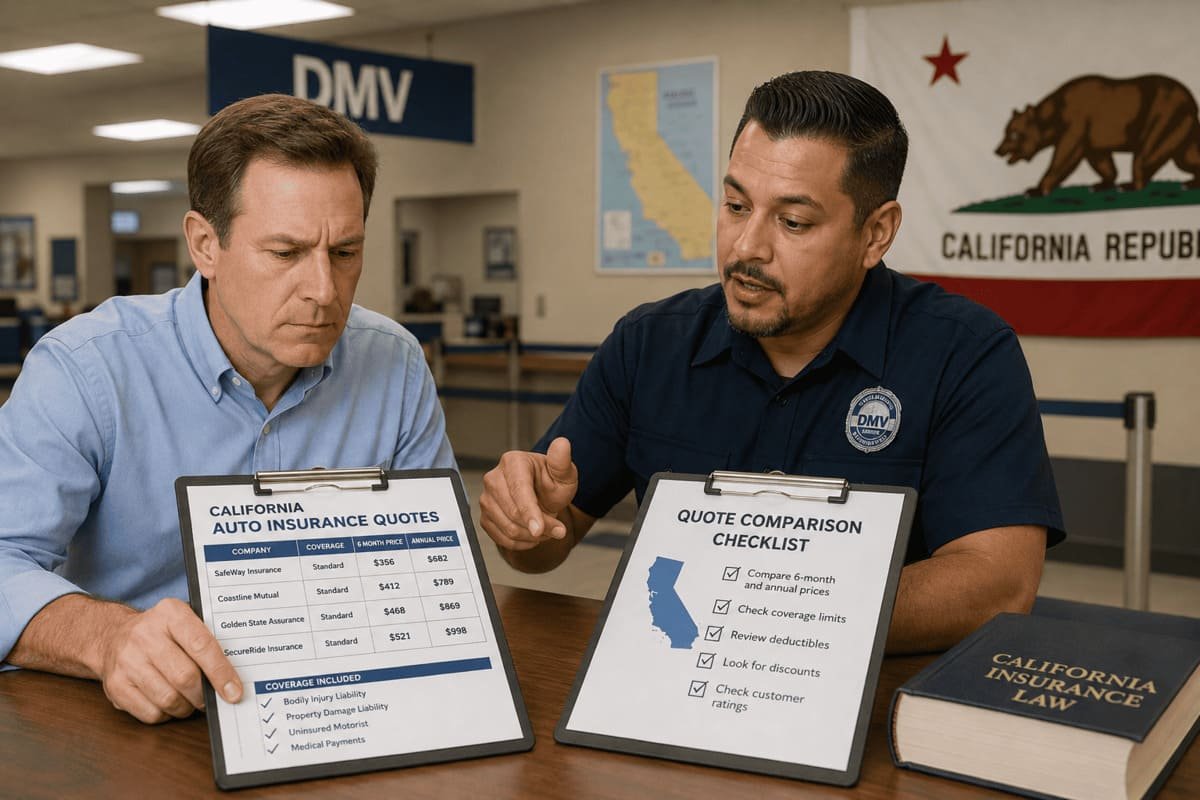
California car insurance laws and California auto insurance compliance are not satisfied by seeing the word “insured” on a quote screen. California car insurance compliance means the chosen form of financial responsibility is valid for the vehicle and driver, the limits meet the applicable rules, the DMV record is handled correctly, and the policy remains effective when the vehicle is operated or parked where coverage is required.
The California insurance law 2026 framework is therefore broader than a minimum-premium question. California standard auto policy minimums changed in 2025, while special programs such as CLCA can follow separate statutory rules. After the legal baseline is understood, California car insurance rates can be compared without confusing a cheaper quote with a weaker or noncompliant setup.
Step 1: Start with the 30/60/15 Standard Liability Floor
California minimum liability insurance and California minimum liability coverage for a standard private-passenger policy are now 30/60/15. California 30/60/15 insurance means $30,000 for bodily injury or death to one person, $60,000 for bodily injury or death to more than one person in one accident, and $15,000 for property damage.
| Legal checkpoint | Current standard minimum | What it addresses |
|---|---|---|
| California bodily injury liability limits | $30,000 one person / $60,000 one accident | Covered bodily injury or death liability to others. |
| California property damage liability limit | $15,000 per accident | Covered damage to another person's property. |
| California auto insurance 30/60/15 | 30/60/15 | The standard-policy shorthand used for the current floor. |
| California car insurance 30/60/15 | 30/60/15 | The same statutory minimum described from a consumer-search perspective. |
California liability insurance 30/60/15 reflects the California auto insurance law change 30/60/15 that took effect for standard policies in 2025. California minimum insurance limits 2025 and California minimum insurance limits 2026 therefore refer to the same current standard floor. California SB 1107 auto insurance is the legislative change associated with the higher standard limits.
California Insurance Code 11580.1 and California Vehicle Code 16056 are core references for California liability policy requirements and the applicable financial-responsibility limits. California liability coverage requirements describe the legal floor; they do not automatically mean those limits are enough protection for every household.
If the goal is to keep liability-focused coverage affordable after the legal floor is fixed, the old useful route to cheap liability insurance is still relevant. Do not lower a valid California policy below the applicable legal requirement merely to create a smaller quote.
Step 2: Match Financial Responsibility to DMV Proof
California financial responsibility law requires drivers and owners to be able to establish financial responsibility. Most people use California financial responsibility insurance through a liability policy, but California DMV recognizes other qualifying methods. California Vehicle Code 16020 is the central carry-and-establish rule behind California evidence of financial responsibility.
| Method | California compliance phrase | What DMV identifies |
|---|---|---|
| Liability policy | California proof of insurance | A motor-vehicle liability policy meeting applicable requirements. |
| Cash deposit | California cash deposit financial responsibility | A California $75,000 cash deposit with DMV. |
| Self-insurance | California self insurance certificate | A DMV-issued self-insurance certificate for qualifying applicants. |
| Surety bond | California surety bond financial responsibility | A California $75,000 surety bond from a company licensed to do business in the state. |
California DMV insurance requirements say evidence must be carried in the vehicle and produced in several situations. The California insurance card requirement is one common way drivers think about that evidence. California DMV proof of insurance can also involve additional documentation depending on the form of financial responsibility.
Three practical trigger phrases matter: California insurance proof for law enforcement, California insurance proof for registration renewal and California insurance proof at collision. The driver should be ready to establish coverage when requested in those situations.
California electronic insurance reporting is also part of the compliance system. California Vehicle Code 16058 requires insurers to report covered vehicle information electronically to DMV. California vehicle registration insurance and California DMV registration renewal insurance therefore depend not only on buying a policy but also on the DMV record receiving or accepting satisfactory proof.
Before buying, verify a California auto insurance licensed insurer or licensed producer when applicable. The California Department of Insurance auto insurance resources include consumer guides and license-checking tools. If several carriers are being considered after compliance is locked, compare California auto insurance companies on the same limits and policy setup.
Step 3: Protect Registration Status Before Cancelling or Parking the Vehicle
California registration suspension insurance problems often begin when the DMV record no longer shows satisfactory financial responsibility. California suspended registration insurance means the owner needs to resolve the proof issue before the vehicle can legally return to normal use on public roadways. California auto insurance lapse registration can therefore become a DMV problem, not merely an insurer billing problem.
California continuous insurance registration is a useful practical concept: if the vehicle remains registered and is operated or parked where insurance is required, avoid a gap between policies. California insurance for parked vehicle matters because DMV states that financial responsibility is required for vehicles operated or parked on California roadways. California insurance for registered vehicle should be evaluated together with the vehicle's actual use and registration status.
California insurance cancellation DMV procedures deserve attention before a policy is cancelled. DMV says owners should notify DMV before cancelling insurance to avoid a registration suspension. California auto insurance cancellation laws and California auto insurance renewal laws can also involve separate policy-notice and contract rules, so do not assume the DMV step is the only legal issue.
| Situation | Compliance term | Practical distinction |
|---|---|---|
| Currently registered vehicle not being driven or parked on a California roadway | California Affidavit of Non-Use insurance | California ANU insurance can be relevant before cancellation when DMV conditions are met. |
| Registration renewal comes due while the vehicle remains out of use | California planned nonoperation insurance | California PNO insurance is a separate registration-status step from ANU. |
| DMV lacks satisfactory proof | California registration suspension insurance | Resolve proof and reinstatement requirements before operating or parking on public roadways. |
The key is timing. Do not cancel first and ask the DMV question later. Confirm the vehicle's use, registration status and alternative filing before ending the policy. That sequence reduces the chance of an avoidable gap between the insurer record and DMV record.
Step 4: Read UM/UIM, Permissive Use and Exclusions as Legal Policy Terms
California uninsured motorist coverage and California underinsured motorist coverage are governed by California Insurance Code 11580.2. California UM UIM insurance should not be treated as a generic optional add-on without reading the offer, limits and any signed agreement.
California uninsured motorist rejection can be made through the written agreement allowed by statute. A California uninsured motorist written waiver therefore deserves the same attention as a coverage purchase: once executed, the agreement can continue to affect the policy and certain renewals or replacements as described by law.
California uninsured motorist limits 30/60 are important because the statute provides an offer structure tied to bodily injury liability limits but does not require the insurer to offer UM limits above 30/60. A California underinsured motorist offer is integrated with the uninsured-motorist framework; underinsured motorist protection is included in policies that provide UM coverage as the statute describes.
California Insurance Code 11580.1 also matters beyond the dollar limits. California permissive use insurance generally starts from the statutory policy provisions extending liability coverage to the named insured and permitted users, subject to statutory exceptions, policy terms and allowed limitations. Do not assume every possible driver or use is automatically covered.
California named driver exclusion rules permit certain exclusions by agreement as provided in the statute. That makes the California auto insurance declarations page and attached endorsements critical. California insurance policy limits, named drivers, excluded drivers, vehicle descriptions and use restrictions should all be checked before relying on a quote.
Collision and comprehensive are different from financial-responsibility liability. If the household is deciding whether to add them after the legal requirements are satisfied, review California collision and comprehensive coverage without confusing optional physical-damage protection with the liability law itself.
Step 5: Know the California SR-1 10-Day Collision Clock
California collision reporting insurance obligations are separate from simply calling an insurer. A California SR-1 accident report must be sent to DMV within 10 days when someone is injured or killed, or when property damage exceeds $1,000. California SR-1 10 days and California accident report 10 days describe the same statutory reporting clock.
| Trigger | DMV action | Important point |
|---|---|---|
| Any injury, even minor | File SR-1 within 10 days | The reporting duty does not depend on who caused the crash. |
| Death | File SR-1 within 10 days | The report is required in addition to other reports. |
| California accident property damage over $1000 | File SR-1 within 10 days | Property-damage threshold alone can make the collision reportable. |
California DMV accident reporting requirements make the driver or representative responsible for filing the SR-1. A police, CHP or insurer report does not substitute for the driver's DMV filing. The SR-1 can also be required for qualifying collisions on private property.
California SR-22 insurance is different from an SR-1. California SR22 requirements arise in certain financial-responsibility situations where DMV requires proof. The California proof of insurance certificate SR-22 is evidence connected to insurance; it is not the collision report itself.
After the DMV reporting obligation is handled, the insurance claim remains a separate process. For the next workflow, review California auto insurance claims rather than assuming an SR-1 opens or settles a claim.
Step 6: Use a Legal Checklist Before Renewal or Switching
A California auto insurance legal checklist should be completed before price shopping. A California car insurance legal checklist is the same idea from the driver's perspective: verify the legal floor, current proof, DMV status, actual drivers, vehicles, exclusions, optional-coverages decisions and effective date before cancelling anything.
| Check | What to verify | Why it matters |
|---|---|---|
| California insurance effective date | Exact date and time the replacement policy begins | Avoids a gap between old and new coverage. |
| California auto insurance declarations page | Drivers, vehicles, limits, deductibles, endorsements and exclusions | Confirms the issued contract matches the intended quote. |
| California auto insurance renewal laws | Read renewal/nonrenewal communications and current policy terms | Do not assume last term's status carries forward unchanged. |
| California auto insurance cancellation laws | Confirm insurer instructions, DMV status and replacement timing | Prevents an avoidable compliance lapse. |
Once compliance is fixed, the shopping phase can begin. The old weak “compare quotes” anchor is replaced by the stronger California rate comparison, where price can be tested using identical coverage and deductibles.
Drivers looking for a lower-cost compliant setup can also separate the legal question from the affordability question. The California Good Driver Discount page covers the affordability ladder, while this page remains focused on law, proof, DMV and policy compliance.
For a separate ZIP-based shopping workflow on one of our related sites, use compare car insurance rates by ZIP Code only after the California liability floor and coverage choices are fixed. The target page uses the same baseline-first principle: compare identical limits and deductibles before trusting the price difference.
The final rule is simple: California auto insurance requirements are a floor, not a shopping strategy. Keep legal compliance stable first, then compare price and provider fit without changing the protection beneath the quote.
California Auto Insurance Laws FAQ
These questions cover the current liability floor, DMV proof, registration continuity, SR-1 reporting, SR-22, UM/UIM and switching checks.
For a standard California auto liability policy, the minimum limits are 30/60/15: $30,000 for bodily injury or death to one person, $60,000 for bodily injury or death to more than one person in one accident, and $15,000 for property damage. These standard limits took effect in 2025.
Yes. California DMV states that evidence of financial responsibility must be carried in the vehicle and provided when requested by law enforcement, when renewing vehicle registration, and when the vehicle is involved in a traffic collision.
Yes. California insurers are required to electronically report covered vehicle information to DMV under the applicable Vehicle Code rules. If the DMV record does not show required coverage, registration can be suspended until satisfactory proof is provided.
Do not simply cancel first. California DMV says owners should notify DMV before cancellation to prevent a registration suspension. If a currently registered vehicle is not being operated and is not parked on a California roadway, an Affidavit of Non-Use may be available; when renewal is due, planned nonoperation rules are separate.
An SR-22 is a California Proof of Insurance Certificate that DMV may require in certain financial-responsibility situations. It is not a separate insurance policy. The insurer files or provides the certificate connected to qualifying liability coverage.
An SR-1 must be sent to DMV within 10 days when anyone is injured or killed, or when property damage exceeds $1,000. The duty applies regardless of fault and is separate from reports made to police, CHP, or an insurance company.
California Insurance Code section 11580.2 generally requires uninsured motorist coverage to be included or offered with bodily injury liability coverage, but a named insured can make a written agreement to delete the coverage or reduce it within statutory limits. Review any waiver carefully before signing.
No. California DMV states that collision and comprehensive do not satisfy the vehicle financial-responsibility requirement. Liability insurance or another legally accepted form of financial responsibility is needed.
No. CLCA is a special statutory program for eligible drivers. Its basic liability limits remain 10/20/3: $10,000 bodily injury per person, $20,000 per accident, and $3,000 property damage, while standard policies use the higher 30/60/15 minimum.
Confirm the insurer is authorized for the transaction, the new policy effective date and time, listed drivers and vehicles, liability limits, optional coverages, deductibles, exclusions, discounts, and the declarations page. Do not create a coverage gap while switching.
Bottom line: California auto insurance laws work as a chain. The standard 30/60/15 liability floor is only the first link. California proof of insurance, DMV electronic reporting, registration status, UM/UIM paperwork, SR-1 deadlines and the replacement policy's effective date all affect whether a driver is actually compliant. Fix those items first; then compare rates, providers and optional coverage without weakening the legal baseline.