
Insurance Company Ratings by ZIP Code
Compare insurance company ratings by ZIP code without treating a local quote, national star score, complaint number, or financial grade as a complete verdict. Use the ZIP code to identify available auto and home insurers, then verify the exact legal company, license, complaint record, financial strength, claims fit, coverage, deductibles, and total policy cost.
Enter the actual overnight garaging ZIP for auto insurance or the insured property's ZIP for home insurance. Keep applicant information, coverage, deductibles, discounts, payment terms, and effective dates consistent.
Compare available auto insurers using accurate drivers, vehicles, mileage, use, limits, physical-damage coverage, deductibles, and optional protection.
The form compares quote options; it does not generate an official regulatory, complaint, financial-strength, or claims-service rating.
Compare home insurers using accurate construction, rebuilding cost, roof, occupancy, claims, liability, property coverage, deductibles, and endorsements.
Verify the legal insurer, policy form, property eligibility, catastrophe deductibles, exclusions, and final underwriting separately.
How to Compare Insurance Company Ratings by ZIP Code
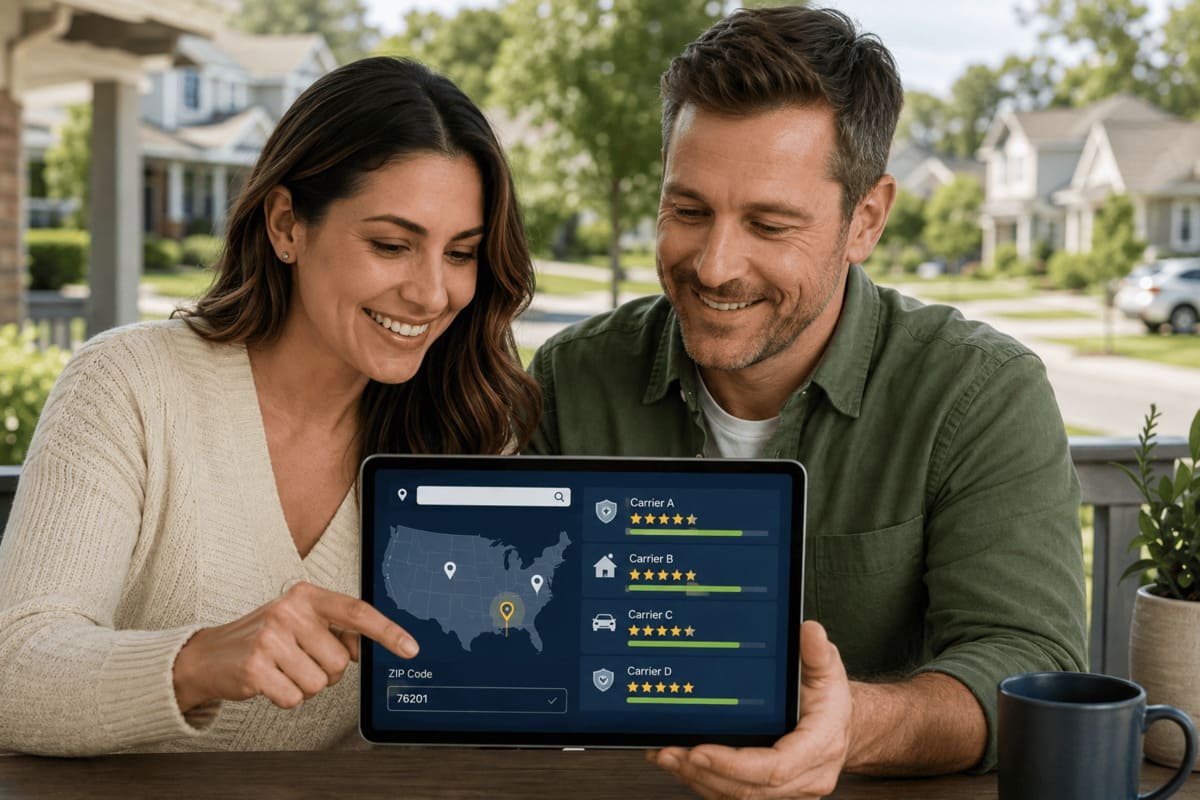
A search for insurance company ratings by ZIP code usually combines several different questions. The shopper wants to know which companies write policies in the location, which ones are financially stable, which have acceptable complaint patterns, which provide useful local claims access, and which offer competitive coverage for the actual driver, vehicle, home, and risk.
Those questions cannot be answered by one national star score. Financial-strength ratings address an insurer's ability to meet ongoing obligations. Regulatory complaint information describes confirmed complaint activity for a legal company and insurance line. Consumer surveys measure selected experiences, while quotes measure price and underwriting fit. Each source answers a different question.
Start with the correct ZIP code to identify available quote paths. Then copy the complete underwriting-company name from each completed quote, binder or declarations page. Insurance groups often use multiple subsidiaries, and the company shown on the policy—not only the parent brand—must be used when checking licensing, complaints and financial information.
Use the NAIC Consumer Insurance Search to research company licensing, complaint, and financial information. Confirm the result through the state insurance department before purchasing.
Confirm that the exact underwriting insurer is authorized for the state and product being purchased.
Compare the correct company, state, insurance line, direct premiums, index or ratio, reasons, and multi-year trend.
Review an independent opinion of the insurer's ability to meet ongoing insurance obligations.
Examine reporting access, adjuster communication, repair or contractor network, rental, towing, and catastrophe response.
Match limits, deductibles, endorsements, replacement-cost treatment, exclusions, and state-specific options.
Compare the full term premium, down payment, installments, fees, discount conditions, deductible exposure, and renewal assumptions.
What a ZIP Code Can and Cannot Tell You
| ZIP-related question | What the ZIP can help show | What requires separate verification |
|---|---|---|
| Company availability | Which insurers or partner quote paths may accept applications in the location | Final underwriting, exact subsidiary, policy form, eligibility, and issuance |
| Territorial pricing | Local exposure can influence an approved quote | The complete driver, vehicle, property, coverage, and discount calculation |
| Local claims environment | Traffic, theft, weather, catastrophe, repair, rebuilding, and service conditions | The insurer's actual claim process, network, staffing, policy terms, and individual loss decision |
| Company quality | The ZIP narrows the relevant market | License, complaint data, financial strength, coverage, service, and total cost |
Use the real principal garaging location for auto insurance and the actual property address for home insurance. A work address, mailing address, former residence, relative's home, or nearby cheaper ZIP should not be substituted when it is not the true risk location.
Verify the Exact Legal Insurance Company
A recognizable insurance brand can contain several underwriting companies. The legal insurer can differ by state, product, distribution channel, acquisition, or applicant. Complaint and financial information for the wrong subsidiary may not describe the company that would issue the policy.
How to Read Insurance Complaint Data
The NAIC compiles closed, confirmed complaint information reported by state insurance departments. Consumer Insurance Search can display company results by complaint code, state, complaint index, financial information and licensing. Always select the correct legal company, state and insurance type.
Do not judge an insurer by a raw complaint count. A larger company may receive more complaints because it writes more business. Compare complaint measures with direct premiums written, the relevant insurance line, company size and a multi-year pattern, then confirm important findings through the applicable state insurance department.
| Complaint check | Correct method | Misleading method |
|---|---|---|
| Company | Use the exact underwriting subsidiary | Use the parent brand or a different affiliated insurer |
| Insurance line | Compare private auto with private auto or homeowners with homeowners | Combine unrelated products into one conclusion |
| Company size | Review complaint measures with direct premiums or market activity | Rank companies only by raw complaint counts |
| Time period | Review several years and note meaningful trends | Use one unusual year as a permanent verdict |
| Overall decision | Combine complaints with financial, coverage, service, and price information | Select or reject a company using one metric alone |
Financial Strength Is Not a Claims-Service Rating
A financial-strength rating is an independent opinion about an insurer's ability to meet ongoing policy and contract obligations. It is important because a policy promise depends on the issuing company's financial capacity.
It does not determine whether a particular claim will be approved, how quickly an adjuster responds, whether the repair experience will be convenient, or whether the policy is suitable for a specific household. It is not a recommendation to buy one policy over another.
Local Auto Insurance Rating Factors
For auto insurance, the ZIP code can help place the vehicle in an approved rating territory, but the applicant and policy remain essential. Compare companies using the same household drivers, VINs, annual mileage, commute, business or rideshare use, garaging, driving history, prior insurance, liability, UM or UIM, PIP or MedPay, collision, comprehensive, deductibles, rental, and roadside coverage.
Congestion, crash frequency, injury severity, road design, and litigation can affect local loss experience.
Vehicle theft, parts theft, glass losses, parking, and anti-theft equipment can affect comprehensive risk.
Labor, parts, calibration, towing, storage, rental duration, and shop capacity can affect claim cost and convenience.
Hail, flood, wildfire, wind, falling objects, and severe weather can affect availability and physical-damage pricing.
Compare the local shortlist with the best auto insurance companies by ZIP code guide and a matched auto quote comparison.
Local Home Insurance Rating Factors
For home insurance, ZIP code alone does not describe the property. Rebuilding cost, construction, roof age and material, renovations, plumbing, electrical systems, heating, occupancy, prior claims, protection devices, wildfire or wind exposure, flood zone, distance to fire protection, and catastrophe deductibles can determine whether a company is available or competitive.
| Home factor | What to compare | Why a rating alone is insufficient |
|---|---|---|
| Dwelling protection | Rebuilding estimate, inflation, extended replacement, ordinance or law, and roof treatment | A highly rated company can still provide a weaker property setup |
| Catastrophe deductibles | All-peril, wind, hail, hurricane, named storm, wildfire, and percentage deductibles | A lower premium may transfer much more loss to the homeowner |
| Water and property endorsements | Water backup, service line, equipment breakdown, valuables, and replacement-cost treatment | Missing endorsements can explain a cheaper quote |
| Claims and contractors | Catastrophe response, adjusters, contractor access, temporary repairs, loss of use, and communication | National reputation may not describe the local claim experience |
Use the home insurance comparison by ZIP code with identical dwelling assumptions and deductibles.
Insurance Company Rating 100-Point Scorecard
Use this scorecard only after the companies and policies have been normalized. It is a decision framework, not an official regulatory rating.
| Score area | Weight | Full-score standard |
|---|---|---|
| License and legal-company verification | 15 points | Correct insurer, state, product, license, and policy entity are confirmed |
| Complaint information | 15 points | Correct company and line show an acceptable multi-year pattern after size is considered |
| Financial strength | 15 points | Current independent financial information supports the insurer's ability to meet obligations |
| Coverage fit | 20 points | Limits, deductibles, endorsements, exclusions, and state-specific protection match actual needs |
| Claims and local service fit | 15 points | Reporting, adjuster, repair or contractor, rental, towing, catastrophe, and communication options are workable |
| Matched total policy cost | 15 points | Full-term premium, payments, fees, discounts, and deductible exposure are competitive |
| Policy stability and clarity | 5 points | Underwriting, cancellation, renewal, documents, and payment conditions are understood |
Verify the current legal insurer, license, complaint information, financial data, coverage, and quote.
Recheck after a meaningful increase, changed discounts, new deductible, endorsement change, or underwriting request.
Use the new actual location and review state rules, territory, availability, claim networks, and catastrophe exposure.
Document the issue, use the policy process, and contact the state insurance department when appropriate.
Review mergers, subsidiary changes, nonrenewal notices, financial changes, product withdrawals, and new policy forms.
Recompare after a new driver, vehicle, roof, renovation, mileage change, business use, or major household change.
National, Regional, Mutual, and Specialist Insurers
Do not restrict the shortlist to the most advertised national brands. Regional and mutual insurers can have a different underwriting appetite, agent network, repair relationships, property expertise, or local pricing. Specialist carriers can matter after a lapse, serious violation, SR-22 or FR-44 filing, unusual vehicle, coastal property, wildfire exposure, or other difficult risk.
Include several genuinely different paths: a direct national insurer, an agent-based company, a regional or mutual insurer, and a specialist option when needed. Then evaluate each legal insurer through the same license, complaint, financial, coverage, service, and cost framework.
Review the broader insurance company ratings guide and top auto insurance provider comparison without treating a national list as a guaranteed local winner.
Build the local shortlist through the insurance companies hub and use Compare Auto Insurance by ZIP to normalize drivers, vehicles, coverage, deductibles, discounts and effective dates.
FAQ About Insurance Company Ratings by ZIP Code
No. ZIP code helps identify available insurers, territorial pricing, and local exposure, but financial strength, regulatory complaint data, licensing, and company identity are generally evaluated at the insurer, state, and product-line level.
Compare the exact legal insurer, state license, complaint history, financial strength, coverage, deductibles, claims access, repair or contractor network, payment terms, exclusions, and complete policy cost.
Check the exact underwriting-company name through the state insurance department and the NAIC Consumer Insurance Search. Do not rely only on the parent brand or agency name.
A complaint index helps compare confirmed complaint activity relative to company size and the market for a specific line. Review the correct insurer, state, product, direct premiums, and several years rather than using one number alone.
No. Financial strength addresses the insurer's ability to meet ongoing obligations. It does not measure every claim decision, customer experience, policy feature, repair process, or suitability for a particular buyer.
Yes. Availability, approved territorial pricing, repair costs, theft, traffic, weather, driver profiles, discounts, and underwriting can make different insurers competitive in different locations.
Yes. Wildfire, wind, hail, hurricane, water, roof, rebuilding cost, fire protection, claims history, and underwriting appetite can change availability and value by property location.
Yes. Include national, regional, mutual, agent-based, direct, and specialist options when available. The strongest local choice is determined after coverage and applicant information are matched.
A practical shortlist includes at least three to five materially different options. Compare the same limits, deductibles, endorsements, discounts, term, payment plan, and effective date.
Review the company before purchase and again after a move, major premium increase, claim-service problem, vehicle or property change, insurer restructuring, or before renewal when considering a switch.
Bottom line: use ZIP code to identify available auto and home quote options, not to invent a universal local rating. Verify the exact legal insurer, license, complaint history, financial strength, claims and service fit, coverage, deductibles, and complete policy cost before switching.