
Progressive Teen Driver Insurance
Progressive teen driver insurance can usually be added to an existing household auto policy, but the price and protection depend on the teen driver's age, permit or license status, vehicle access, location, driving history, and selected limits. Families should compare the complete policy rather than choosing the lowest first payment.
This guide explains how Progressive insurance for teen drivers generally works, which discounts may apply, what information parents should prepare, and how to compare matching estimates by ZIP. State rules, underwriting, availability, and the written policy control the final result.
Use the garaging ZIP and keep drivers, vehicles, liability limits, physical damage, deductibles, and effective dates consistent. The forms are independent comparison tools and do not submit an application directly to Progressive.
Use the garaging ZIP and keep drivers, vehicles, liability limits, physical damage, and deductibles consistent.
Compare the same household, vehicle use, limits, deductibles, and effective date on every estimate.
Test a home-and-auto bundle against equivalent standalone policies without weakening either policy.
Compare the total policy-term cost, confirmed savings, deductibles, fees, and effective dates.
How Progressive Teen Driver Insurance Coverage Works
A licensed or permitted teen driver generally needs to be disclosed to the insurer when the household allows that person to drive. Timing rules differ by state and company, so parents should ask when a learner must be listed instead of assuming coverage begins automatically.
Adding a Teen to a Progressive Auto Policy
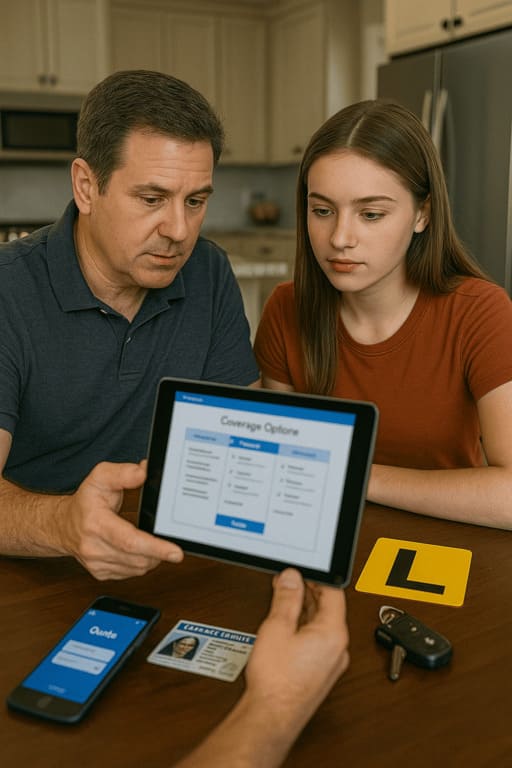
In many households, adding a young driver to a parent's existing policy costs less than purchasing a separate policy for the teenager. The established household policy may also be easier to manage because the same billing, documents, vehicles, and claim contacts remain together.
Once listed, the teen driver may have access to the vehicles and protection shown on the policy. Do not assume the teenager is protected only while driving one named car. Confirm how each household driver and vehicle is rated, who regularly uses each vehicle, and whether occasional use changes the price.
Current customers can generally request a driver change through their account or by contacting Progressive. New customers can include the teenager during the application. Parents should provide the real permit or license date, school status, garaging address, expected mileage, commute, vehicle use, and prior incidents.
When reviewing the revised premium, compare more than the monthly payment. Check whether the teen driver is rated on a specific vehicle, whether occasional access to other household cars is included, and how collision and comprehensive deductibles affect the full policy-term cost. Also confirm whether good student, distant student, driver training, multi-car, or Snapshot savings are already applied or still require enrollment or documentation. Save the updated declarations page and verify the effective date, listed drivers, vehicles, limits, deductibles, and endorsements.
Progressive Coverage to Review for a Teen Driver
The correct Progressive teen driver coverage is not simply the state minimum. A family should evaluate the household's financial exposure, vehicle values, financing requirements, deductible budget, medical protection, and the teenager's likely use of every listed vehicle.
| Policy area | What it generally addresses | What parents should compare |
|---|---|---|
| Liability | Covered injuries or property damage for which an insured driver is legally responsible | Bodily injury limits, property damage limits, exclusions, and household assets at risk |
| Collision | Covered damage to an insured vehicle after a collision, minus the deductible | Vehicle value, repair cost, deductible, financing, and whether removal is financially sensible |
| Comprehensive | Covered non-collision losses such as theft, hail, fire, vandalism, or animal contact | Deductible, vehicle value, local risk, lender requirements, and exclusions |
| UM/UIM | Protection subject to state and contract terms when another driver lacks enough insurance | Available limits, rejection rules, bodily injury treatment, and property damage treatment |
| PIP or medical payments | Medical-related protection where offered or required | State rules, limits, deductibles, coordination, and covered expenses |
| Optional protection | Roadside assistance, rental reimbursement, loan or lease payoff, and other available features | Limits, fees, exclusions, duplicate benefits, and the family's actual need |
Raising a deductible can lower the premium but increases the amount due after a covered loss. Removing collision or comprehensive may reduce cost on an older car, but the family then accepts more repair or replacement risk. Test each change separately and save the full result.
Progressive Teen Driver Discounts
Progressive lists several savings categories for eligible young drivers. Availability is not identical in every state, and an advertised category does not guarantee that a particular household will qualify. Confirm the requirement, proof, effective date, and renewal treatment on the written offer.
Progressive teen driver discount
Progressive states that a driver age 18 or younger may qualify after the household has maintained qualifying insurance with Progressive for at least 12 months. State availability and policy conditions apply.
Progressive good student discount
A full-time student under age 23 with a B average or better may qualify. Progressive states that the saving starts at 5% in most states, but documentation and local rules should be verified.
Progressive distant student discount
A full-time student age 22 or younger may qualify when attending school at least 100 miles from home without a vehicle at school. Confirm how visits home and vehicle access are treated.
Multi-car and multi-policy
Listing more than one vehicle or combining eligible policies may reduce the household total. Compare the confirmed bundled price with equivalent standalone offers.
Additional savings may relate to payment method, continuous insurance, online documents, homeowner status, prior driving history, or other eligibility factors. Similar programs cannot always be combined, so compare only credits that are actually shown.
Progressive's current requirements are summarized on its official teen car insurance guide. The declarations page and policy documents remain controlling.
How Snapshot May Affect a Young Driver's Rate
Snapshot is Progressive's usage-based program. It can consider driving behavior and how much or when a vehicle is driven. Depending on state rules and recorded results, participation may produce savings, no meaningful change, or a higher rate.
For a household with multiple drivers, confirm how trips are assigned and corrected in the mobile app. Phone use, hard braking, rapid acceleration, late-night driving, mileage, and other listed factors may influence the result. Parents should not count an estimated Snapshot saving before the insurer applies it.
| Snapshot checkpoint | Question to ask | Reason |
|---|---|---|
| Enrollment | Which vehicles and household drivers participate? | Participation and trip assignment can affect the recorded profile. |
| Collected information | Which driving events and phone behaviors are measured in this state? | Program operation and available technology can vary. |
| First-term credit | Is a participation credit already included, and when does it expire? | An initial credit may differ from the renewal result. |
| Renewal outcome | Can the personalized result increase the price? | Progressive states that high-risk driving can raise the rate in most participating states. |
Learner Permits, Licenses, and Household Disclosure
A permit holder still needs legally sufficient insurance while learning to drive. The exact point at which a teenager must be formally listed can depend on state law, permit status, residence, vehicle ownership, and company procedure. Contact the insurer before regular practice begins.
If the young driver lives in two households, attends school away from home, uses another parent's vehicle, or owns a separate car, disclose those facts. Do not assume another policy automatically resolves the household's listing obligations.
What Changes the Cost of Progressive Insurance for Teen Drivers?
Age and limited driving experience are important, but they are not the only rating factors. Price can also reflect ZIP code, vehicle type, safety and repair characteristics, annual mileage, driving use, household records, prior insurance, selected limits, deductibles, discounts, and available underwriting information.
Vehicle choice
Compare realistic repair cost, safety features, theft exposure, financing requirements, and the premium for each available household vehicle.
Driving use
State who commutes, who drives to school, where each car is kept, and the expected annual mileage. Incorrect use data can invalidate a comparison.
Limits and deductibles
A cheaper result may simply contain lower liability limits, higher deductibles, or fewer optional protections.
Tickets and accidents
Violations and claims can affect eligibility, price, and renewal. Report requested information accurately.
How to Compare Progressive Teen Driver Quotes
Start with one written baseline and use it for every company. List the same drivers and vehicles, request the same limits, match collision and comprehensive deductibles, and use the same effective date. Then evaluate one change at a time.
| Comparison item | What must match |
|---|---|
| Household | All licensed or permitted residents, regular operators, addresses, and school status |
| Vehicles | VIN, ownership, financing, garaging, primary use, annual mileage, and driver access |
| Protection | Liability, UM/UIM, PIP or medical payments, collision, comprehensive, and endorsements |
| Out-of-pocket exposure | Every deductible, excluded loss, fee, first payment, and installment amount |
| Savings | Applied discounts, required proof, Snapshot participation, expiration, and renewal rules |
| Policy term | Total premium, effective date, cancellation terms, and issuing insurance company |
Do not compare only monthly payments. One estimate may use a different term length, installment fee, down payment, or protection level. A fair Progressive teen driver quote comparison uses the total policy-term cost and matching insurance terms.
Practical Safety and Policy Steps for Parents
Establish written rules for phone use, passengers, nighttime driving, seat belts, speeding, and who may use each vehicle. These rules do not guarantee a lower premium, but they can reduce preventable risk and support more responsible driving.
Review the declarations page after adding the teenager. Confirm the driver's name, license status, vehicles, limits, deductibles, endorsements, applied savings, billing schedule, and effective date. Keep student records or course completion documents when proof may be required.
Recheck the policy after a move, new vehicle, school change, college departure, license change, accident, ticket, or major shift in mileage. A stale household record can produce an inaccurate price or complicate a claim.
Related Progressive and Young Driver Guides
FAQ About Progressive Teen Driver Insurance
It is often less expensive to add a young driver to an established household policy than to buy a separate policy, but the result depends on the drivers, vehicles, location, limits, deductibles, and underwriting.
Ask Progressive when the teenager receives a permit or begins regular practice. State law and policy procedures determine when the learner must be formally listed.
Progressive states that drivers age 18 or younger may qualify after at least 12 months of qualifying insurance with Progressive. Availability and conditions vary by state and policy.
An eligible full-time student under age 23 with a B average or better may qualify. Progressive states that the saving starts at 5% in most states, subject to documentation and local rules.
Yes. Progressive states that Snapshot can produce a higher rate for high-risk driving in most participating states. Review enrollment, trip assignment, measured behavior, and renewal treatment first.
A listed teen driver generally uses the protection and limits shown on the household policy. Confirm vehicle access, driver assignments, exclusions, and policy-specific terms in writing.
Use the same drivers, vehicles, limits, deductibles, optional protection, discounts, and effective date. Compare the total policy-term premium rather than only the first or monthly payment.
Bottom line: Progressive teen driver insurance should be evaluated as a complete household policy. Disclose the young driver on time, protect liability limits, test deductibles carefully, verify every discount, and compare matching written terms before choosing a carrier.